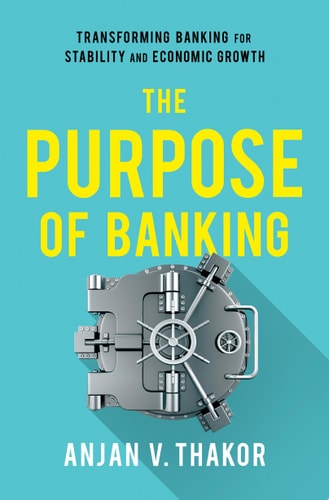
The Purpose of Banking: Transforming Banking for Stability and Economic Growth
0
0
As an Amazon Associate and affiliate partner, Menrva Books earns from qualifying purchases. Learn more
Author Description
Banks and other financial institutions play a fundamental and yet divisive role in the health of any economy. As lenders they are important to everyone seeking a mortgage or a car loan. As investors they are essential gears of economic progress. And yet when crises hit and the economy tumbles, they are vilified.Is it possible for the banking and financial sectors to both be crisis-free and sustain economic growth that benefits everyone? This is the central question that Anjan Thakor, one of the leading analysts of banking and financial institutions, takes up in this insightful overview of the purpose of banking. He starts with the foundations of banks as safe-keepers of assets and providers of liquidity crucial to a dynamic economy. They manage risk, monitor borrowers, create trust, are providers of information, and facilitate innovation. And yet notwithstanding these essential purposes, the reputation of banks has suffered tremendously in the wake of crises that have harmed the financial sector, the real economy, and many people.The reason, Thakor argues, is that banks have lost sight of their higher purpose, which is tied to their role as safe-keepers of assets and creators of value. These essential economic functions should drive banks' culture, capital structure, and customer relationships. Credit ratings cannot replace relationships, leverage is no substitute for judgment, and the pursuit of profit should not come at the expense of prudence. Thakor shows that while governments can play an important role in creating the environment of banks, including through microprudential and macroprudential regulation, ultimately it is up to banks to improve their culture and align it with their purpose in society.
Menrva's Summary
THE THESIS
Can the banking and financial sectors operate in a manner that remains crisis-free while simultaneously sustaining inclusive economic growth? Anjan V. Thakor, a prominent analyst of financial institutions, examines the fundamental disconnect between the societal purpose of banks and their current operational practices. He argues that by refocusing on their core functions—such as asset safekeeping, liquidity provision, and risk management—banks can realign their internal cultures and capital structures to better serve the broader economy.
THE SCOPE MAP
What You Will Find
- Analysis of the historical and economic foundations of banking institutions
- Frameworks for aligning corporate culture with long-term societal value
- Evaluation of the interplay between government regulation and private banking responsibility
Scope Limits
- The text does not provide a comprehensive technical manual for specific banking software or algorithmic trading systems
- It does not offer a detailed historical account of every global financial crisis in the twentieth century
THE AUTHORITY PERSPECTIVE
Experts recognize this work as a significant contribution to the discourse on financial ethics and institutional reform. Readers frequently note the clarity with which the author bridges the gap between complex economic theory and practical organizational management.
Page Count:
242
Publication Date:
2019-01-01
Publisher:
Oxford University Press
ISBN-10:
0190919558
ISBN-13:
9780190919559
Economics
Business
Principles of Macroeconomics
Corporate governance
Money & BankingMonetary Theory
Banking law
Finance
Banking
Community Tags
Similar Books