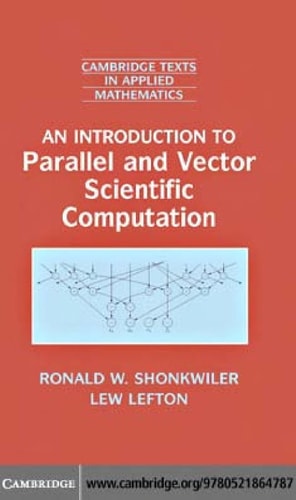
An Introduction to Parallel and Vector Scientific Computation
0
0
As an Amazon Associate and affiliate partner, Menrva Books earns from qualifying purchases. Learn more
Author Description
In this text, students of applied mathematics, science and engineering are introduced to fundamental ways of thinking about the broad context of parallelism. The authors begin by giving the reader a deeper understanding of the issues through a general examination of timing, data dependencies, and communication. These ideas are implemented with respect to shared memory, parallel and vector processing, and distributed memory cluster computing. Threads, OpenMP, and MPI are covered, along with code examples in Fortran, C, and Java. The principles of parallel computation are applied throughout as the authors cover traditional topics in a first course in scientific computing. Building on the fundamentals of floating point representation and numerical error, a thorough treatment of numerical linear algebra and eigenvector/eigenvalue problems is provided. By studying how these algorithms parallelize, the reader is able to explore parallelism inherent in other computations, such as Monte Carlo methods.
Menrva's Summary
THE THESIS
This text introduces students to the core concepts of parallel and vector scientific computation, focusing on the practical implementation of these ideas in various computing architectures. The authors, Lew Lefton and Ronald W. Shonkwiler, begin by establishing a foundational understanding of parallelism through discussions on timing, data dependencies, and communication. These principles are then applied to shared memory, parallel and vector processing, and distributed memory cluster computing, with coverage of Threads, OpenMP, and MPI, supported by code examples in Fortran, C, and Java. The book integrates these parallel computation concepts with traditional scientific computing topics, including floating-point representation, numerical error, numerical linear algebra, and eigenvector/eigenvalue problems, demonstrating how algorithms parallelize and extending this understanding to other computations like Monte Carlo methods.
THE SCOPE MAP
- Introduction to fundamental concepts of parallelism in scientific computation.
- Detailed examination of timing, data dependencies, and communication issues.
- Implementation of parallel concepts in shared memory, parallel/vector processing, and distributed memory cluster computing.
- Coverage of Threads, OpenMP, and MPI with code examples in Fortran, C, and Java.
- Application of parallel principles to traditional scientific computing topics.
- Thorough treatment of floating-point representation and numerical error.
- In-depth coverage of numerical linear algebra and eigenvector/eigenvalue problems.
- Exploration of parallelism inherent in computations such as Monte Carlo methods.
THE AUTHORITY PERSPECTIVE
This textbook is designed for students in applied mathematics, science, and engineering, offering a comprehensive introduction to parallel and vector scientific computation. The authors meticulously build from fundamental concepts of floating-point representation and numerical error to advanced topics in numerical linear algebra and eigenvalue problems, all through the lens of parallel processing. The inclusion of practical code examples in multiple languages and coverage of key parallel programming models like OpenMP and MPI equip readers with the tools to understand and implement parallel algorithms. The text's approach allows students to grasp the underlying principles of parallelism by studying how standard algorithms can be adapted for parallel execution, thereby fostering a deeper understanding of computational efficiency and scalability.
Page Count:
300
Publication Date:
2006-08-14
Publisher:
Cambridge University Press
ISBN-10:
0521683378
ISBN-13:
9780521683371
Science
Non-Fiction
Computer Science
Linear Algebra
Scientific Computing
Numerical analysis
Community Tags
Similar Books