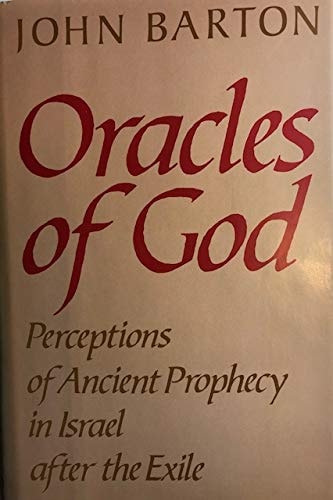
Oracles of God: Perceptions of Ancient Prophecy in Israel after the Exile
0
0
As an Amazon Associate and affiliate partner, Menrva Books earns from qualifying purchases. Learn more
Author Description
Examining perceptions of ancient Hebrew prophecy current in Judaism and Christianity from the time of the Exile to the end of the New Testament period, this book throws fresh light on the development of the Prophetic section of the Old Testament canon in both the Hebrew and Greek traditions. Drawing on documents including the Old Testament itself, the Apocrypha and Pseudepigrapha, the New Testament, the writings of Philo and Josephus, and the works of the early Church Fathers, Barton arrives at a series of controversial conclusions about the composition of the canon in the post-exilic period, the relation of "apocalyptic" to prophecy, and even the applicability of the term "prophet" to the classical prophets themselves.
Menrva's Summary
THE THESIS
This work investigates how the perception of ancient Hebrew prophecy evolved within Judaism and Christianity from the post-exilic period through the conclusion of the New Testament era. John J. Barton, a scholar of biblical studies, utilizes a wide array of primary sources to challenge conventional understandings of how the prophetic canon was formed. By analyzing the transition from classical prophecy to later apocalyptic traditions, he argues that the very definition of a prophet underwent significant shifts that influenced both Hebrew and Greek religious traditions.
THE SCOPE MAP
What You Will Find
- Analysis of the development of the Prophetic section of the Old Testament canon.
- Comparative study of Hebrew and Greek textual traditions.
- Examination of diverse primary sources including the Apocrypha, Pseudepigrapha, Philo, Josephus, and early Church Fathers.
- Critical re-evaluation of the relationship between apocalyptic literature and classical prophecy.
THE AUTHORITY PERSPECTIVE
Scholars and students of theology frequently cite this text for its rigorous examination of canonical development and its willingness to challenge established academic paradigms. The prose is noted for its high level of academic density, making it a standard reference for those engaged in advanced biblical research.
Page Count:
336
Publication Date:
1988-10-20
Publisher:
Oxford University Press
ISBN-10:
0195207149
ISBN-13:
9780195207149
History
Religion
Theology
Christianity
Judaism
Oracles
Prophets
Community Tags
Similar Books