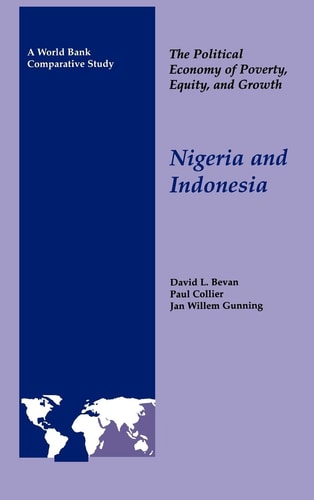
The Political Economy of Poverty, Equity, and Growth: Nigeria and Indonesia
0
0
As an Amazon Associate and affiliate partner, Menrva Books earns from qualifying purchases. Learn more
Author Description
This volume analyzes and compares economic growth in Nigeria and Indonesia during the period from 1950 to 1985, addressing questions as to why one country was so much more successful than the other. Providing some surprising answers for those who believed that the divergence would be found in deeply rooted, long term trends, the authors also offer insight into what has become a reversal of fortune in the late 1990's, as Indonesia has experienced decline, and the Nigerian economy has stabilized.
Menrva's Summary
THE THESIS
This study investigates the divergent economic trajectories of Nigeria and Indonesia between 1950 and 1985 to determine why one nation achieved significant growth while the other stagnated. The authors, David Bevan, Jan Willem Gunning, and Paul H. Collier, utilize a comparative political economy framework to analyze how specific policy decisions and institutional responses to oil windfalls shaped national outcomes. By examining the interaction between government action and economic performance, the text challenges conventional wisdom regarding long-term structural determinants of growth. The analysis extends into the late 1990s to account for shifting fortunes, providing a comprehensive assessment of how political choices influence macroeconomic stability.
THE SCOPE MAP
What You Will Find
- Comparative analysis of economic growth patterns in Nigeria and Indonesia from 1950 to 1985.
- Evaluation of the impact of oil revenue windfalls on domestic fiscal policy and agricultural sectors.
- Examination of institutional decision-making processes and their role in economic divergence.
- Longitudinal assessment of policy outcomes and their subsequent effects on national stability.
THE AUTHORITY PERSPECTIVE
Experts recognize this work as a foundational comparative study in development economics, frequently cited for its rigorous application of political economy to real-world policy outcomes. Readers often note the academic density of the prose, which requires a solid grasp of macroeconomic principles to fully appreciate the authors' arguments.
Page Count:
480
Publication Date:
1999-10-07
Publisher:
World Bank
ISBN-10:
0195209869
ISBN-13:
9780195209860
History
Economics
Indonesia
Nigeria
Poverty
Community Tags
Similar Books