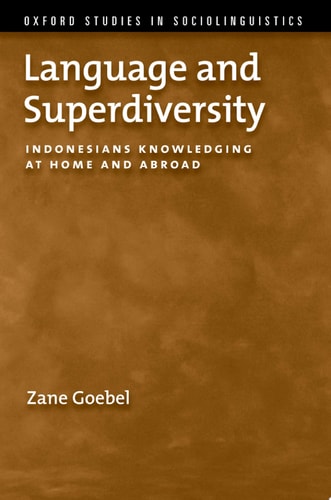
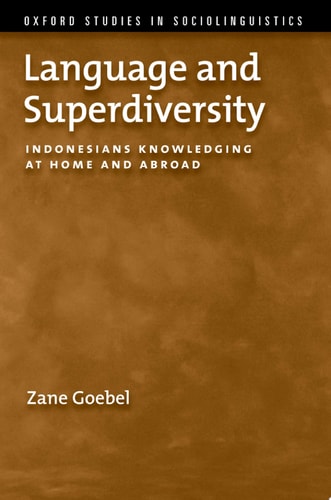
Language and Superdiversity: Indonesians Knowledging at Home and Abroad
0
0
As an Amazon Associate and affiliate partner, Menrva Books earns from qualifying purchases. Learn more
Author Description
Scholars of language ideology have encouraged us to reflect on and explore where social categories come from, how they have been reproduced, and whether and to what extent they are relevant to everyday interactional practices. Taking up on these issues, this book focuses on how ethnicity has been semiotically constructed, valued, and reproduced in Indonesia since Dutch colonial times, and how this category is drawn upon in everyday talk. In doing so, this book also seeks to engage with scholarship on superdiversity while highlighting some points of engagement with work on ideas about community. The book draws upon a broad range of scholarship on Indonesia, recordings of Indonesian television from the mid-1990s onwards, and recordings of the talk of Indonesian students living in Japan. It is argued that some of the main mechanisms for the reproduction and revaluation of ethnicity and its links with linguistic form include waves of technological innovations that bring people into contact (e.g. changes in transportation infrastructure, introduction of print media, television, radio, the internet, etc.), and the increasing use of one-to-many participation frameworks such as school classrooms and the mass media. In examining the talk of sojourning Indonesians the book goes on to explore how ideologies about ethnicity are used to establish and maintain convivial social relations while in Japan. Maintaining such relationships is not a trivial thing and it is argued that the pursuit of conviviality is an important practice because of its relationship with broader concerns about eking out a living.
Menrva's Summary
THE THESIS
This book investigates how ethnicity is semiotically constructed, valued, and reproduced in Indonesia from the colonial era to the present, and how these ideologies influence social interaction. Zane Goebel, a scholar in sociolinguistics, utilizes a framework that bridges historical analysis with contemporary interactional data. He argues that technological innovations and institutional participation frameworks, such as mass media and education, serve as primary mechanisms for the revaluation of ethnic categories and their connection to linguistic forms.
THE SCOPE MAP
What You Will Find
- Historical analysis of ethnic construction in Indonesia since Dutch colonial times
- Examination of one-to-many participation frameworks including classrooms and mass media
- Analysis of linguistic practices among Indonesian students residing in Japan
- Theoretical engagement with the concept of superdiversity and community ideologies
Scope Limits
- The study does not provide a comprehensive history of all Indonesian ethnic groups
- The analysis of sojourning Indonesians is limited to those living in Japan
THE AUTHORITY PERSPECTIVE
Experts recognize this work as a significant contribution to the study of language ideologies and the sociolinguistics of globalization. Readers frequently note the academic density of the prose, which is intended for scholars and advanced students in the fields of anthropology and linguistics.
Page Count:
304
Publication Date:
2015-01-01
Publisher:
Oxford University Press
ISBN-10:
0190273232
ISBN-13:
9780190273231
History
Communication Studies
English
Communications
Ethnicity
Linguistics
Cultural Anthropology
Superdiversity
Indonesia
Anthropology
Introduction to Human Communication
English & College Success
Asian History
Community Tags
Other Editions(2)
Similar Books