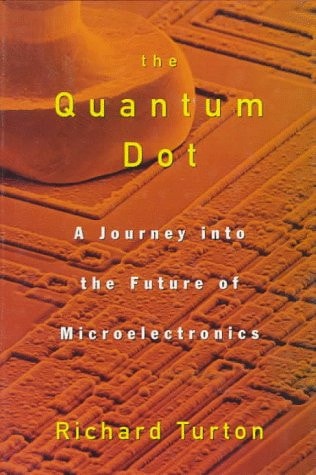
The Quantum Dot: A Journey into the Future of Microelectronics
0
0
As an Amazon Associate and affiliate partner, Menrva Books earns from qualifying purchases. Learn more
Author Description
Since first developed in the early sixties, silicon chip technology has made vast leaps forward. From a rudimentary circuit with a mere handful of transistors, the chip has evolved into a technological miracle, packing millions of bits of information on a surface no larger than a human thumbnail. And most experts predict that in the near future, we will see chips with over a billion bits. At the same time, this revolution in microelectronics has sparked a dramatic change in the way we live. An integral part of the computer industry, the microchip is found in everything from lasers, fax machines, and satellites to greeting cards and children's toys. And yet few people have any idea how chips work, or how so much information can be captured in such a miniscule space.Now, in The Quantum Dot, physicist Richard Turton provides a clear, informative look at the science that lies behind the modern revolution in microelectronics and offers an intriguing glimpse of the possible future of this rapidly evolving field. Turton illuminates the development of the microchip, in a discussion that ranges from a primer on atoms and electrons, to the properties of semiconductors (most notably, silicon), to the structure of the transistor. We learn how researchers have managed to pack the tiny silicon chip with more and more bits, and we get a state-of-the-art look at the microelectronic industry today, from the newest chip materials (such as gallium arsenide, a much faster material than silicon, used in the recently released Cray 3 supercomputer) to the exotic world of high-temperature superconductors. Perhaps most interesting, Turton offers a provocative glimpse of the future of microelectronics. Here readers enter the strange realm where quantum theory prevails and where physical events contradict our intuitive perceptions. Turton shows how researchers are leaving the transistor far behind as they struggle to exploit quantum effects to create incredibly small and fast devices.
Menrva's Summary
THE THESIS
This book investigates the scientific principles and historical evolution of microelectronics, questioning how silicon technology has achieved such extreme miniaturization and what physical limits define its future. Physicist Richard J. Turton draws upon his expertise to explain the transition from basic transistor mechanics to the complex, quantum-level engineering required for next-generation computing. The text provides a technical framework for understanding semiconductors, material science, and the shift toward quantum-based device architecture.
THE SCOPE MAP
What You Will Find
- Historical development of silicon chip technology from the 1960s to the present.
- Fundamental principles of atomic physics, electron behavior, and semiconductor properties.
- Comparative analysis of materials like silicon versus gallium arsenide in high-performance computing.
- Exploration of quantum theory applications in the design of future microelectronic devices.
THE AUTHORITY PERSPECTIVE
Experts and readers frequently cite this work as a highly accessible introduction to the physics of microchips for a general audience. The text is noted for its ability to bridge the gap between foundational semiconductor theory and the speculative, complex realm of quantum electronics.
Page Count:
224
Publication Date:
1995-08-24
Publisher:
Oxford University Press
ISBN-10:
019521157X
ISBN-13:
9780195211573
Science
Physics
Technology
Engineering
Semiconductors
Community Tags
Similar Books