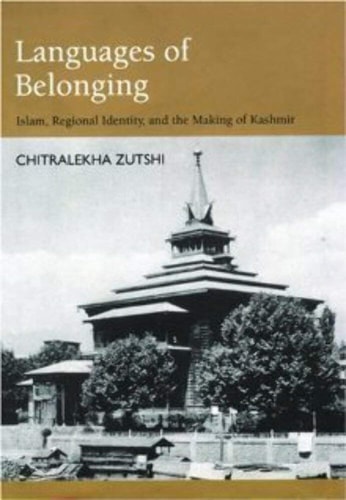
Languages of Belonging: Islam, Regional Identity, and the Making of Kashmir
0
0
As an Amazon Associate and affiliate partner, Menrva Books earns from qualifying purchases. Learn more
Author Description
Despite its centrality to the political life of India and Pakistan, Kashmir has met with rather perfunctory treatment from historians of South Asia. The few works of history and politics that have appeared on this region, moreover, insist on defining Kashmiri culture, history, and identity in terms of the ahistorical concept of Kashmiriyat, or a uniquely Kashmiri cultural identity. This book, in contrast, questions the notion of any transcendent cultural uniqueness and Kashmiriyat by returning Kashmir to the mainstream of South Asian historiography. It examines the hundred-year impact of indirect colonial rule on Kashmirs class formation. It studies the uses (and abuses) made of Kashmirs political elites by the state. It looks at the responses of Kashmirs society to social and economic restructuring. It shows that while all these historical changes had a profound impact on the political culture of the Kashmir Valley, there is nothing very inevitable or quite definite about the 'political regionalism' and 'Islamic particularism' of this area. Using local language sources and every important archive, this major history of the formation of Kashmir shows precisely how the Kashmir Valley assumed the position it has come to occupy in postcolonial South Asia.
Menrva's Summary
THE THESIS
This book investigates the historical construction of Kashmiri identity by challenging the ahistorical concept of Kashmiriyat and examining the region's integration into broader South Asian political frameworks. Dr. Chitralekha Zutshi, a scholar of South Asian history, utilizes extensive archival research and local language sources to dismantle the notion of a transcendent, unique Kashmiri culture. She argues that the region's current political regionalism and Islamic particularism are not inevitable outcomes but are instead the products of specific historical processes, including colonial rule and elite political maneuvering.
THE SCOPE MAP
What You Will Find
- An analysis of the hundred-year impact of indirect colonial rule on class formation in the Kashmir Valley.
- A critical examination of how political elites were utilized and manipulated by the state apparatus.
- A study of societal responses to significant economic and social restructuring.
- Evidence derived from local language sources and comprehensive archival documentation.
THE AUTHORITY PERSPECTIVE
Scholars and historians recognize this work as a critical intervention in South Asian historiography for its rigorous rejection of essentialist narratives regarding Kashmiri identity. Readers frequently note the academic density of the prose and the author's meticulous use of primary sources to ground her arguments in historical reality.
Page Count:
320
Publication Date:
2004-06-03
Publisher:
Oxford University Press
ISBN-10:
0195219392
ISBN-13:
9780195219395
History
Colonialism
Islam And Politics
India - History
Islam
Community Tags
Similar Books