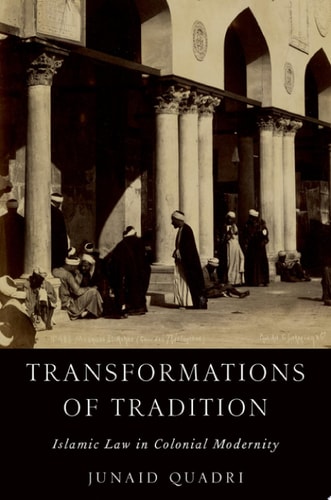
Transformations of Tradition: Islamic Law in Colonial Modernity
0
0
As an Amazon Associate and affiliate partner, Menrva Books earns from qualifying purchases. Learn more
Author Description
Transformations of Tradition probes how the encounter with colonial modernity conditioned Islamic jurists' conceptualizations of the shari'a. Departing from the tendency to focus on reformist-minded thinkers and politically charged issues, Junaid Quadri directs his attention towards the overlooked jurisprudential writings of Muhammad Bakhit al-Muti-i (1854-1935), Mufti of Egypt and a frequent critic of the famed reformists Muhammad 'Abduh and Rashid Rida. There, he locates a remarkable series of foundational intellectual shifts. Offering a fresh perspective on a pivotal period in the history of Islamic thought, Quadri tracks how Bakhit reworks the relationship of the shari'a to categories of understanding as fundamental as history and authority, science and technology, and religion and the secular, thereby upending the very ground upon which Islamic law had until then functioned. Through close readings of complex legal texts and mining of oft-neglected archives, this carefully researched study situates its argument in both the contested scholarly world of a quickly-changing Cairo, and the transregional school of Hanafi law as represented by jurists writing in Kazan, Lucknow, and Baghdad. Examining Islamic jurisprudential discourse in the colonial moment, Transformations of Tradition uncovers a shari'a that is neither a medieval holdover nor merely a pragmatic concession to the demands of a new world, but rather deeply entangled with the epistemological commitments of colonial modernity.
Menrva's Summary
THE THESIS
This work investigates how the encounter with colonial modernity fundamentally reshaped the conceptual framework of Islamic law as understood by early 20th-century jurists. Junaid Quadri, a scholar of Islamic law and history, utilizes the neglected jurisprudential corpus of Muhammad Bakhit al-Muti-i to challenge prevailing narratives that focus exclusively on reformist thinkers. By analyzing these primary texts, Quadri argues that the shari'a underwent significant epistemological shifts, becoming deeply entangled with modern categories of history, science, and the secular rather than remaining a static medieval tradition.
THE SCOPE MAP
What You Will Find
- Analysis of the jurisprudential writings of Muhammad Bakhit al-Muti-i.
- Comparative study of Hanafi legal discourse across Cairo, Kazan, Lucknow, and Baghdad.
- Examination of the intersection between Islamic law and colonial-era epistemological shifts.
Scope Limits
- The study does not focus on the well-documented reformist agendas of Muhammad 'Abduh or Rashid Rida.
- The research is limited to the specific legal discourse of the late 19th and early 20th centuries.
THE AUTHORITY PERSPECTIVE
Scholars in the field of Islamic legal history identify this text as a significant contribution to understanding the intellectual complexity of the colonial period. Readers frequently note the academic density of the prose, which requires a foundational knowledge of Islamic jurisprudence to fully appreciate the author's arguments.
Page Count:
258
Publication Date:
2021-03-26
Publisher:
Oxford University Press
ISBN-10:
0190077042
ISBN-13:
9780190077044
History
World
Colonialism
Religious
General
Law
New Used & Rental Textbooks
Middle Eastern
Jurisprudence
Islamic Studies
Church & State
Legal History
Middle East
Islam
Islamic Law
Community Tags
Similar Books