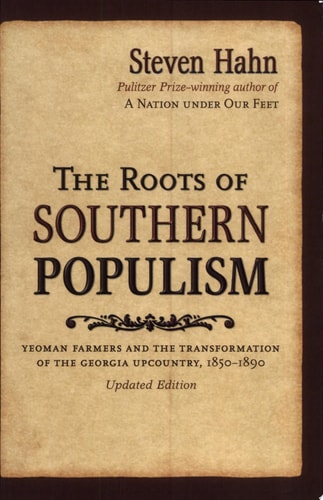
The Roots of Southern Populism: Yeoman Farmers and the Transformation of the Georgia Upcountry, 1850-1890
0
0
As an Amazon Associate and affiliate partner, Menrva Books earns from qualifying purchases. Learn more
Author Description
Despite the vast changes in plantation agriculture following the Civil War and Reconstruction, the lot of small farmers was little improved. Examining the nonplantation region of upcountry Georgia as a microcosm of the South, Steven Hahn showed how farmers were buffeted by such forces as the unravelling of antebellum household economy, the development of market forces, the growth of a new class of merchants-landlords, and rising tensions between town and countryside--and how their resentments fueld the Populist movement at the end of the 19th century. For this updated edition, Hahn will add new material to discuss how the book has stood up since it was published over twenty years ago, how the arguments and questions were received, and what influence they may have had on scholarship. He will also consider what has happened to historical interest in Populism, poor white people and populist politics, as well as why he thinks it likely that interest may revive and what sort of questions and arguments may drive it.
Menrva's Summary
THE THESIS
This work investigates how the economic and social transformation of the Georgia upcountry during the mid-to-late 19th century catalyzed the rise of the Populist movement among small-scale farmers. Steven Hahn, a historian specializing in the American South, utilizes extensive archival research and economic data to trace the decline of the antebellum household economy. He argues that the encroachment of market forces and the emergence of a merchant-landlord class created systemic pressures that fundamentally altered the lives of yeoman farmers, ultimately driving them toward political radicalism.
THE SCOPE MAP
What You Will Find
- Analysis of the transition from subsistence-based household economies to market-integrated agriculture.
- Examination of the socio-economic impact of the merchant-landlord class in the Georgia upcountry.
- Historical investigation of the period between 1850 and 1890, covering the Civil War and Reconstruction eras.
- Evaluation of the political tensions between rural farming communities and growing urban commercial centers.
THE AUTHORITY PERSPECTIVE
Scholars frequently cite this text as a foundational study for understanding the intersection of class, geography, and political mobilization in the post-Civil War South. The prose is noted for its academic rigor and its ability to synthesize complex economic shifts into a coherent narrative of social change.
Page Count:
376
Publication Date:
2006-05-18
Publisher:
Oxford University Press
ISBN-10:
0195306708
ISBN-13:
9780195306705
History
Economics
Americas
Categories
Kindle Store
American History
Political History
Southern History
Populism
Social History
Kindle eBooks
Southern States
Community Tags
Similar Books