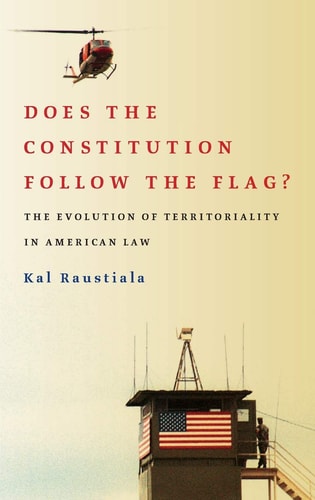
Does the Constitution Follow the Flag?: The Evolution of Territoriality in American Law
0
0
As an Amazon Associate and affiliate partner, Menrva Books earns from qualifying purchases. Learn more
Author Description
The Bush Administration has notoriously argued that detainees at Guantanamo do not enjoy constitutional rights because they are held outside American borders. But where do rules about territorial legal limits such as this one come from? Why does geography make a difference for what legal rules apply? Most people intuitively understand that location affects constitutional rights, but the legal and political basis for territorial jurisdiction is poorly understood. In this novel and accessible treatment of territoriality in American law and foreign policy, Kal Raustiala begins by tracing the history of the subject from its origins in post-revolutionary America to the Indian wars and overseas imperialism of the 19th century. He then takes the reader through the Cold War and the globalization era before closing with a powerful explanation of America's attempt to increase its extraterritorial power in the post-9/11 world. As American power has grown, our understanding of extraterritorial legal rights has expanded too, and Raustiala illuminates why America's assumptions about sovereignty and territory have changed. Throughout, he focuses on how the legal limits of territorial sovereignty have diminished to accommodate the expanding American empire, and addresses how such limits ought to look in the wake of Iraq, Afghanistan, and the war on terror. A timely and engaging narrative, Does the Constitution Follow the Flag? will change how we think about American territory, American law, and-ultimately-the changing nature of American power.
Menrva's Summary
THE THESIS
This book investigates the historical and legal origins of territoriality in American law to determine why geography dictates the application of constitutional rights. Kal Raustiala, a professor of law and international relations, utilizes a combination of historical analysis and legal theory to examine how the United States has navigated the boundaries of its sovereignty. He argues that the concept of territorial jurisdiction has evolved significantly from the 19th century to the post-9/11 era, reflecting shifts in American geopolitical power and imperial ambition.
THE SCOPE MAP
What You Will Find
- Historical analysis of territorial legal limits from post-revolutionary America through the Indian wars.
- Examination of extraterritorial legal rights during the Cold War and the era of globalization.
- Case studies regarding the legal status of detainees in Guantanamo and the war on terror.
- A framework for understanding the relationship between American sovereignty and expanding foreign policy.
THE AUTHORITY PERSPECTIVE
Legal scholars and historians recognize this work as a comprehensive examination of the intersection between geography and constitutional authority. Readers frequently note the clarity of the prose, which makes complex legal doctrines accessible to those outside the field of constitutional law.
Page Count:
328
Publication Date:
2009-06-18
Publisher:
Oxford University Press
ISBN-10:
0195304594
ISBN-13:
9780195304596
Politics
History
Kindle eBooks
Systems Theory
World politics
United States
American History
Kindle Store
Categories
Specific Topics
Fiction political
International relations
Americas
Fiction legal
Law
Constitutional Law
Community Tags
Similar Books