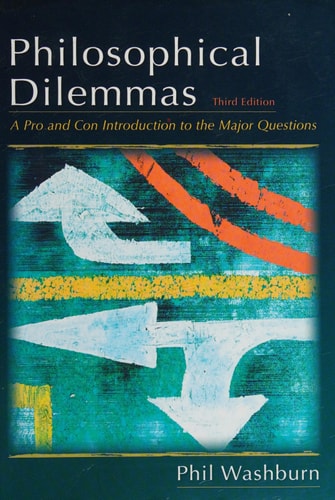
Philosophical Dilemmas: A Pro and Con Introduction to the Major Questions
0
0
As an Amazon Associate and affiliate partner, Menrva Books earns from qualifying purchases. Learn more
Author Description
For students with little or no background in the subject, the pursuit of philosophical knowledge can be a difficult and confusing enterprise. In order to formulate their own personal worldviews, students need to know how and where to begin, what choices they have, and why anyone would adopt one basic belief over another. Philosophical Dilemmas: A Pro and Con Introduction to the Major Questions, Third Edition, outlines the principal positions that philosophers have articulated through the ages, helping students to understand what philosophers do and how they do it. Comprehensive and lucidly written, it features sixty-four brief essays--arranged in sets of two or three--on thirty-one important questions. The essays are arguments that author Phil Washburn has either created or recreated, rather than excerpts from the work of philosophers. With affirmative and negative responses, each set answers one of the standard philosophical questions, such as "Does God exist?" or "Is morality relative?" Each essay takes a definite stand and promotes it vigorously, creating a sharp contrast between the two positions and giving each abstract theory a more personal and believable "voice." While the essays often employ traditional arguments of great philosophers, they present the ideas in contemporary language with vivid examples. The accessible style and conflicting answers encourage students to examine the different positions and to think carefully about which essay makes the stronger case. In contrast with other textbooks, which often present a series of excerpts and theories without attempting to coordinate them into a larger picture, Philosophical Dilemmas teaches students about the process of thinking philosophically and encourages them to construct their own coherent worldviews. This third edition features two new sections (four new essays) on the meaning of life and on personal identity, expanded and updated annotated bibliographies, and an appendix, "How to Write an Essay."
Menrva's Summary
THE THESIS
This book investigates the core question of how students can navigate complex philosophical inquiries to construct their own coherent personal worldviews. Author Phil Washburn, an experienced educator, addresses the confusion often faced by beginners by providing a structured, dialectical framework. By presenting sixty-four original essays that argue opposing sides of thirty-one fundamental questions, Washburn demonstrates the methodology of philosophical reasoning rather than merely summarizing historical texts.
THE SCOPE MAP
What You Will Find
- A collection of sixty-four original essays organized into thirty-one distinct philosophical debates.
- A pedagogical methodology that pairs affirmative and negative arguments for each question to highlight logical contrasts.
- Contemporary language and vivid, modern examples used to illustrate abstract concepts.
- Practical instructional tools including an appendix on essay writing and updated annotated bibliographies.
THE AUTHORITY PERSPECTIVE
Educators and students frequently identify this text as a highly accessible entry point for undergraduate philosophy courses due to its clear, non-academic prose style. Experts highlight the book's unique structure as a successful tool for teaching critical thinking and the mechanics of argumentation.
Page Count:
528
Publication Date:
2007-12-26
Publisher:
Oxford University Press
ISBN-10:
0195314646
ISBN-13:
9780195314649
Philosophy
Metaphysics
Philosophy
Education
textbook
Ethics
Logic
Community Tags
Similar Books