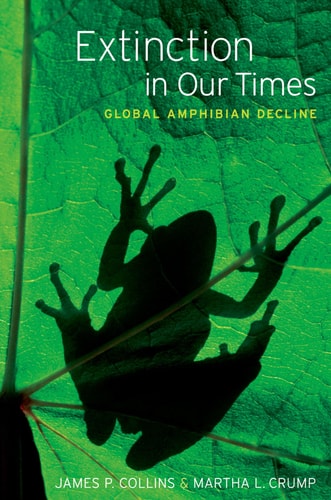
Extinction in Our Times: Global Amphibian Decline
0
0
As an Amazon Associate and affiliate partner, Menrva Books earns from qualifying purchases. Learn more
Author Description
For over 350 million years, thousands of species of amphibians have lived on earth, but since the 1990s they have been disappearing at an alarming rate, in many cases quite suddenly and mysteriously. What is causing these extinctions? What role do human actions play in them? What do they tell us about the overall state of biodiversity on the planet? In Extinction in Our Times, James Collins and Martha Crump explore these pressing questions and many others as they document the first modern extinction event across an entire vertebrate class, using global examples that range from the Sierra Nevada of California to the rainforests of Costa Rica and the Mediterranean coast of North Africa. Joining scientific rigor and vivid storytelling, this book is the first to use amphibian decline as a lens through which to see more clearly the larger story of climate change, conservation of biodiversity, and a host of profoundly important ecological, evolutionary, ethical, philosophical, and sociological issues.
Menrva's Summary
THE THESIS
This book investigates the causes and broader ecological implications of the rapid, mysterious, and global decline of amphibian populations that began in the 1990s. Authors James P. Collins and Martha L. Crump utilize their extensive backgrounds in ecology and biology to synthesize data from diverse geographical regions, including the Sierra Nevada, Costa Rica, and North Africa. They argue that the extinction of this vertebrate class serves as a critical indicator for the current state of global biodiversity and the accelerating impacts of human-driven environmental change.
THE SCOPE MAP
What You Will Find
- Global case studies of amphibian population collapse across multiple continents.
- Analysis of the intersection between climate change and vertebrate extinction events.
- Examination of the sociological and ethical dimensions of modern conservation efforts.
- Scientific framework for understanding biodiversity loss as a systemic ecological crisis.
THE AUTHORITY PERSPECTIVE
Experts recognize this work as a foundational text for understanding the specific mechanisms behind the amphibian extinction crisis. Readers frequently note the balance between rigorous scientific documentation and accessible prose, making it a standard reference for students and professionals in conservation biology.
Page Count:
304
Publication Date:
2009-07-07
Publisher:
Oxford University Press
ISBN-10:
0195316940
ISBN-13:
9780195316940
Science
Nature
Amphibians
Biological Diversity
Ecology
Conservation
Biology
Community Tags
Similar Books