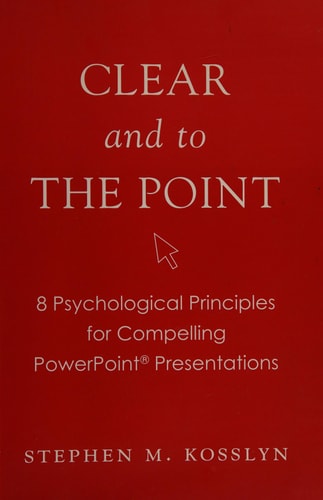
Clear and to the Point: 8 Psychological Principles for Compelling PowerPoint Presentations
0
0
As an Amazon Associate and affiliate partner, Menrva Books earns from qualifying purchases. Learn more
Author Description
True or False?Most PowerPoint presentations are:BLcompelling BLilluminating BLinformative BLclear and to the pointAnswer: FalseMake a change following the principles of Stephen Kosslyn:BLa world authority on the visual brain BLa clear and engaging writerMaking PowerPoint presentations that are clear, compelling, memorable, and even enjoyable is not an obscure art. In this book, Stephen Kosslyn, a renowned cognitive neuroscientist, presents eight simple principles for constructing a presentation that takes advantage of the information modern science has discovered about perception, memory, and cognition. Using hundreds of images and sample slides, he shows the common mistakes many people make and the simple ways to fix them. For example, never use underlining to emphasize a word--the line will cut off the bottom of letters that have descending lines (such as p and g), which interferes with the brain's ability to recognize text. Other tips include why you should state your conclusion at the beginning of a presentation, when to use a line graph versus a bar graph, and how to use color correctly. By following Kosslyn's principles, anyone will be able to produce a presentation that works!
Menrva's Summary
THE THESIS
How can the principles of cognitive neuroscience be applied to create more effective and memorable PowerPoint presentations? Stephen M. Kosslyn, a renowned cognitive neuroscientist, leverages his expertise in the visual brain to provide a practical framework for slide design. By examining how the human brain processes perception, memory, and cognition, he argues that effective presentation design is a science rather than an obscure art. The book translates complex psychological research into actionable guidelines for professional communication.
THE SCOPE MAP
What You Will Find
- Eight core psychological principles for visual information design
- Analysis of common presentation errors and their cognitive impact
- Practical guidance on typography, color usage, and data visualization
- Extensive use of visual examples and before-and-after slide comparisons
THE AUTHORITY PERSPECTIVE
Experts recognize this work as a foundational text for professionals seeking to improve their visual communication through evidence-based design. Readers frequently note that the prose is accessible and the practical examples make the psychological concepts immediately applicable to daily work tasks.
Page Count:
222
Publication Date:
2007-08-13
Publisher:
Oxford University Press
ISBN-10:
0195320697
ISBN-13:
9780195320695
Non-Fiction
Psychology
Business
Education
Microsoft Powerpoint Computer Program
Technology
Communication
Community Tags
Similar Books