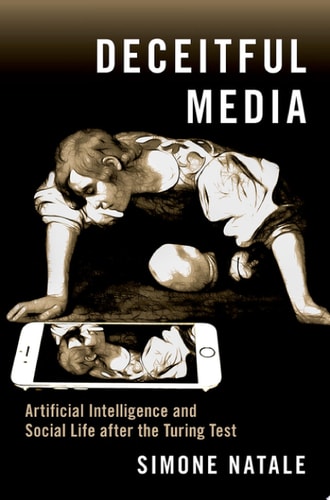
Deceitful Media: Artificial Intelligence and Social Life after the Turing Test
0
0
As an Amazon Associate and affiliate partner, Menrva Books earns from qualifying purchases. Learn more
Author Description
Artificial intelligence (AI) is often discussed as something extraordinary, a dream--or a nightmare--that awakens metaphysical questions on human life. Yet far from a distant technology of the future, the true power of AI lies in its subtle revolution of ordinary life. From voice assistants like Siri to natural language processors, AI technologies use cultural biases and modern psychology to fit specific characteristics of how users perceive and navigate the external world, thereby projecting the illusion of intelligence. Integrating media studies, science and technology studies, and social psychology, Deceitful Media examines the rise of artificial intelligence throughout history and exposes the very human fallacies behind this technology. Focusing specifically on communicative AIs, Natale argues that what we call "AI" is not a form of intelligence but rather a reflection of the human user. Using the term "banal deception," he reveals that deception forms the basis of all human-computer interactions rooted in AI technologies, as technologies like voice assistants utilize the dynamics of projection and stereotyping as a means for aligning with our existing habits and social conventions. By exploiting the human instinct to connect, AI reveals our collective vulnerabilities to deception, showing that what machines are primarily changing is not other technology but ourselves as humans. Deceitful Media illustrates how AI has continued a tradition of technologies that mobilize our liability to deception and shows that only by better understanding our vulnerabilities to deception can we become more sophisticated consumers of interactive media.
Menrva's Summary
THE THESIS
This book investigates the core question of how artificial intelligence functions not as a form of machine intelligence, but as a mechanism of human deception. Simone Natale, a scholar in media and communication studies, utilizes a multidisciplinary framework that integrates media theory, science and technology studies, and social psychology. He argues that AI technologies rely on 'banal deception,' exploiting human cognitive biases and social conventions to project an illusion of intelligence that reflects the user rather than the machine.
THE SCOPE MAP
What You Will Find
- Historical analysis of communicative technologies and their relationship to human deception.
- A theoretical framework defining 'banal deception' in human-computer interaction.
- Examination of voice assistants and natural language processing as tools of psychological projection.
- Analysis of how AI exploits human instincts for social connection and stereotyping.
Scope Limits
- The book does not provide a technical manual for AI development or programming.
- It does not focus on the future of autonomous robotics or speculative superintelligence.
THE AUTHORITY PERSPECTIVE
Scholars in media studies and sociology frequently cite this work for its critical approach to the anthropomorphism of digital tools. Experts highlight the text as a necessary intervention in contemporary debates regarding the social impact of algorithmic systems.
Page Count:
208
Publication Date:
2021-01-01
Publisher:
Oxford University Press
ISBN-10:
0190080396
ISBN-13:
9780190080396
Psychology
History
Technology
Sociology
Earth Sciences
Communications
Professional Career & Trade
Communication
Introduction to Human Communication
Media Studies
Community Tags
Similar Books