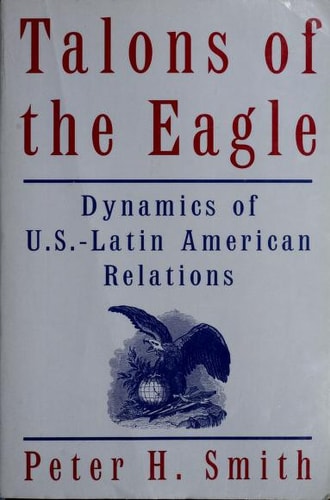
Talons of the Eagle: Latin America, the United States, and the World
0
0
As an Amazon Associate and affiliate partner, Menrva Books earns from qualifying purchases. Learn more
Author Description
After the terrorist attacks of September 11, 2001, a new international regime emerged and profoundly transformed inter-American affairs. In the third edition of Talons of the Eagle: Latin America, the United States, and the World, Peter H. Smith places this devastating event into its full historical context by offering a vivid portrayal of U.S.-Latin American relations from the early nineteenth century to the present. A new section, "The War on Terror," examines the impact of 9/11 on the United States and Latin America, with a focus on George W. Bush's Latin American policy. Smith also analyzes Latin American reactions and responses to the U.S.--and to the rest of the world--in these complex and troubling times.Throughout, this provocative text casts new light on such contemporary issues as economic integration, drug trafficking, undocumented migration, and the rise of Latin America's "new left." Rather than concentrating solely on U.S. policy, Smith addresses the structural relationships between the two regions by focusing on international systems, the distribution of power, and the perception and pursuit of national interests.Designed explicitly for classroom use, this new edition integrates photographs, political cartoons, charts, and tables directly into the text. To further enliven the subject, anecdotal sidebars highlight such incendiary and discussion-worthy topics as the origins of anti-imperialist sentiment in Latin America, Che Guevara's hopes for continental revolution, Ronald Reagan's denunciation of communist threats in Central America, George W. Bush's justifications for the war in Iraq, and Hugo Ch´ávez's anti-Bush remarks at the United Nations.Deftly researched and thoughtfully composed, this text is ideal for general courses in Latin American history and politics as well as courses in U.S. foreign policy and inter-American relations. Timely and topical, Talons of the Eagle, Third Edition, presents an eminent scholar's perspective on the interaction
Menrva's Summary
THE THESIS
How have the structural power dynamics between the United States and Latin America evolved from the nineteenth century through the post-9/11 era? Peter H. Smith, a distinguished scholar in the field, utilizes a historical and systemic framework to examine the shifting geopolitical landscape of the Western Hemisphere. By analyzing the distribution of power and the pursuit of national interests, Smith argues that inter-American relations are defined by complex, reciprocal interactions rather than unilateral U.S. dominance alone.
THE SCOPE MAP
What You Will Find
- Historical analysis of U.S.-Latin American relations from the early 1800s to the early 21st century.
- Examination of the impact of the post-9/11 international security regime on regional policy.
- Discussion of contemporary challenges including economic integration, drug trafficking, and migration.
- Integration of primary source materials, political cartoons, and data-driven charts to illustrate diplomatic shifts.
THE AUTHORITY PERSPECTIVE
Experts and educators frequently cite this text as a foundational resource for undergraduate courses in international relations and regional history. Readers note the balanced, analytical approach that avoids simplistic narratives in favor of a nuanced structural perspective.
Page Count:
448
Publication Date:
2007-12-07
Publisher:
Oxford University Press
ISBN-10:
0195320484
ISBN-13:
9780195320480
History
International relations
Foreign Policy
United States
Community Tags
Similar Books