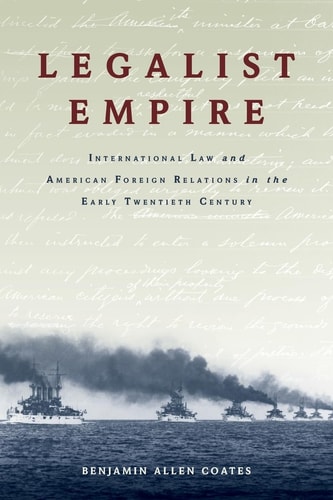
Legalist Empire: International Law and American Foreign Relations in the Early Twentieth Century
0
0
As an Amazon Associate and affiliate partner, Menrva Books earns from qualifying purchases. Learn more
Author Description
America's empire expanded dramatically following the Spanish-American War of 1898. The United States quickly annexed the Philippines and Puerto Rico, seized control over Cuba and the Panama Canal Zone, and extended political and financial power throughout Latin America. This age of empire, Benjamin Allen Coates argues, was also an age of international law. Justifying America's empire with the language of law and civilization, international lawyers-serving simultaneously as academics, leaders of the legal profession, corporate attorneys, and high-ranking government officials-became central to the conceptualization, conduct, and rationalization of US foreign policy.Just as international law shaped empire, so too did empire shape international law. Legalist Empire shows how the American Society of International Law was animated by the same notions of "civilization" that justified the expansion of empire overseas. Using the private papers and published writings of such figures as Elihu Root, John Bassett Moore, and James Brown Scott, Coates shows how the newly-created international law profession merged European influences with trends in American jurisprudence, while appealing to elite notions of order, reform, and American identity. By projecting an image of the United States as a unique force for law and civilization, legalists reconciled American exceptionalism, empire, and an international rule of law. Under their influence the nation became the world's leading advocate for the creation of an international court.Although the legalist vision of world peace through voluntary adjudication foundered in the interwar period, international lawyers-through their ideas and their presence in halls of power-continue to infuse vital debates about America's global role
Menrva's Summary
THE THESIS
This book investigates how international lawyers in the early twentieth century utilized the language of law and civilization to conceptualize, justify, and conduct American imperial expansion. Benjamin Allen Coates, a historian of U.S. foreign relations, examines the intersection of legal theory and geopolitical power. By analyzing the private papers and public writings of influential figures like Elihu Root and John Bassett Moore, Coates argues that these legalists reconciled the contradictions between American exceptionalism and the realities of overseas empire through a framework of international rule of law.
THE SCOPE MAP
What You Will Find
- Analysis of the American Society of International Law and its foundational ideologies
- Examination of the relationship between American jurisprudence and European legal influences
- Investigation into the role of legal professionals as government officials and corporate advisors
Scope Limits
- The study focuses primarily on the early twentieth century and does not provide an exhaustive history of American foreign policy throughout the entire century
- The text prioritizes the perspectives of elite legalists rather than the experiences of populations within the annexed territories
THE AUTHORITY PERSPECTIVE
Scholars and historians recognize this work as a significant contribution to the understanding of how legal discourse shaped the development of American global power. Readers frequently note the academic density of the prose and the meticulous archival research that supports the author's arguments.
Page Count:
298
Publication Date:
2019-04-01
Publisher:
Oxford University Press
ISBN-10:
0190055588
ISBN-13:
9780190055585
Politics
History
International Law
Americas
Politics & Government
Professional Career & Trade
American History
New Used & Rental Textbooks
Imperialism
World politics
Foreign Policy
United States
Legal History
Law
Community Tags
Similar Books