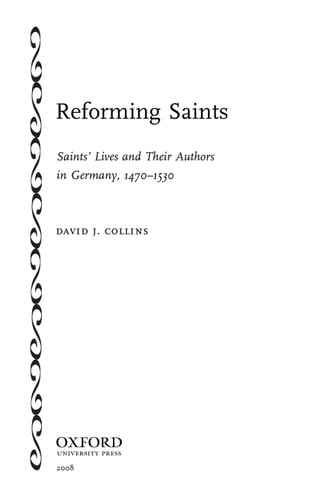
Reforming Saints: Saints' Lives and Their Authors in Germany, 1470-1530
0
0
As an Amazon Associate and affiliate partner, Menrva Books earns from qualifying purchases. Learn more
Author Description
In Reforming Saints, David J. Collins explains how and why Renaissance humanists composed Latin hagiography in Germany in the decades leading up to the Reformation. Contrary to the traditional wisdom, Collins's research uncovers a resurgence in the composition of saints' lives in the half century leading up to 1520. German humanists, he finds, were among the most active authors and editors of these texts.Focusing on forty Latin depictions of German saints written between 1470 and 1520, Collins finds patterns both in how these humanists chose their subjects and how they presented their holiness. He argues that the humanist hagiographers took up the writing of saints' lives to investigate Germany's medieval past, to reconstruct and exalt its greatness, and to advocate programs of religious and cultural reform. This literature, says Collins, left a legacy that polemicists and philologists in Catholic Europe would be using for their own purposes by the end of the sixteenth century. These hagiographic writings are thus both reflective and formative of the religious and cultural conflicts that defined this period of European history. To bolster his case, Collins draws not only on the Latin saints' lives, but also on vernacular lives, maps and chorographic documents, personal and professional letters, papal, urban, and municipal archives, painting, sculpture and broadside print, and medieval and early modern histories and chronicles. The result is a fresh, new portrait of the humanism of Renaissance Germany.With his surprising and insightful conclusions, Collins sheds new light on humanism's appropriation in Germany, particularly in its religious aspect. He approaches the humanists' writings on their own terms and recaptures the creative energy the humanists brought to the task of revising the legends of the saints. His scholarly perspective includes the roles of emperors, princes, abbots, city councilmen, artists, librarians, soldiers, peasants, and pilgrims, showing how
Menrva's Summary
THE THESIS
This book investigates the resurgence of Latin hagiography in Renaissance Germany and how humanist authors utilized these texts to shape religious and cultural reform. David J. Collins, a scholar of historical theology, examines forty Latin depictions of German saints written between 1470 and 1520 to challenge the assumption that interest in saints' lives waned before the Reformation. By analyzing these texts alongside archival documents, visual art, and correspondence, Collins argues that humanists actively reconstructed Germany's medieval past to advocate for specific programs of religious and cultural renewal.
THE SCOPE MAP
What You Will Find
- Analysis of forty Latin hagiographies written by German humanists between 1470 and 1520.
- Examination of the intersection between Renaissance humanism and medieval religious traditions.
- Integration of diverse primary sources including vernacular lives, chorographic documents, personal letters, and municipal archives.
- Investigation of how hagiographic literature served as a tool for political and religious identity formation in pre-Reformation Europe.
THE AUTHORITY PERSPECTIVE
Scholars recognize this work as a significant contribution to the study of German humanism and its complex relationship with religious tradition. Readers frequently note the academic density of the prose and the depth of the archival research presented by the author.
Page Count:
246
Publication Date:
2008-01-29
Publisher:
Oxford University Press
ISBN-10:
0195329538
ISBN-13:
9780195329537
Philosophy
Politics
History
Renaissance
Catholicism
Religious History
European History
Kindle Store
Categories
Europe
Germany
Saints
Church History
Hagiography
Authorship
Church Leadership
Kindle eBooks
Humanism
Movements
Theology
Community Tags
Other Editions(2)

Similar Books












Reader Comments
Share Your Thoughts
No comments yet. Be the first to share your thoughts!