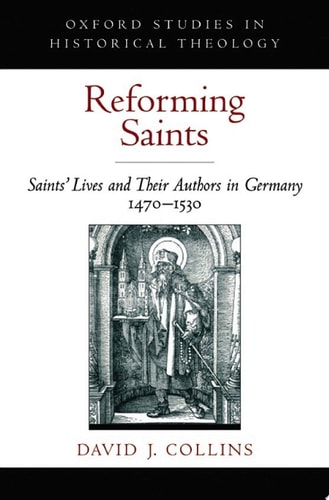
Reforming Saints: Saints' Lives and Their Authors in Germany, 1470-1530
0
0
As an Amazon Associate and affiliate partner, Menrva Books earns from qualifying purchases. Learn more
Author Description
In Reforming Saints, David J. Collins explains how and why Renaissance humanists composed Latin hagiography in Germany in the decades leading up to the Reformation. Contrary to the traditional wisdom, Collins's research uncovers a resurgence in the composition of saints' lives in the half century leading up to 1520. German humanists, he finds, were among the most active authors and editors of these texts. Focusing on forty Latin depictions of German saints written between 1470 and 1520, Collins finds patterns both in how these humanists chose their subjects and how they presented their holiness. He argues that the humanist hagiographers took up the writing of saints' lives to investigate Germany's medieval past, to reconstruct and exalt its greatness, and to advocate programs of religious and cultural reform. This literature, says Collins, left a legacy that polemicists and philologists in Catholic Europe would be using for their own purposes by the end of the sixteenth century. These hagiographic writings are thus both reflective and formative of the religious and cultural conflicts that defined this period of European history. To bolster his case, Collins draws not only on the Latin saints' lives, but also on vernacular lives, maps and chorographic documents, personal and professional letters, papal, urban, and municipal archives, painting, sculpture and broadside print, and medieval and early modern histories and chronicles. The result is a fresh, new portrait of the humanism of Renaissance Germany. With his surprising and insightful conclusions, Collins sheds new light on humanism's appropriation in Germany, particularly in its religious aspect. He approaches the humanists' writings on their own terms and recaptures the creative energy the humanists brought to the task of revising the legends of the saints. His scholarly perspective includes the roles of emperors, princes, abbots, city councilmen, artists, librarians, soldiers, peasants, and pilgrims, showing ho
Menrva's Summary
THE THESIS
This work investigates the motivations and methodologies of Renaissance humanists in Germany who composed Latin hagiography between 1470 and 1530. David J. Collins, a scholar of religious history, argues that these humanists utilized the lives of saints as a vehicle to explore Germany's medieval past, promote cultural identity, and advocate for specific religious and social reforms. By analyzing forty distinct Latin depictions of German saints, the author demonstrates that this literary activity was a deliberate, creative effort to reshape the religious landscape during the pre-Reformation era.
THE SCOPE MAP
What You Will Find
- An analysis of forty Latin hagiographic texts written by German humanists between 1470 and 1520.
- A multi-disciplinary methodology incorporating archival research, art history, and cartography.
- Examination of the intersection between humanist intellectual pursuits and the political interests of emperors, princes, and urban leaders.
Scope Limits
- The study focuses primarily on Latin-language hagiography, with only secondary consideration given to vernacular traditions.
- The analysis is geographically constrained to the German-speaking territories of the Holy Roman Empire.
THE AUTHORITY PERSPECTIVE
Scholars recognize this text as a significant contribution to the study of Renaissance humanism and its complex relationship with religious tradition. Readers frequently note the academic density of the prose and the breadth of primary source material utilized to support the author's conclusions.
Page Count:
228
Publication Date:
2008-01-01
Publisher:
Oxford University Press
ISBN-10:
0190450142
ISBN-13:
9780190450144
History
Religion
Theology
Modern History
Humanism
Hagiography
German history
Religious History
Community Tags
Other Editions(2)
Similar Books












Reader Comments
Share Your Thoughts
No comments yet. Be the first to share your thoughts!