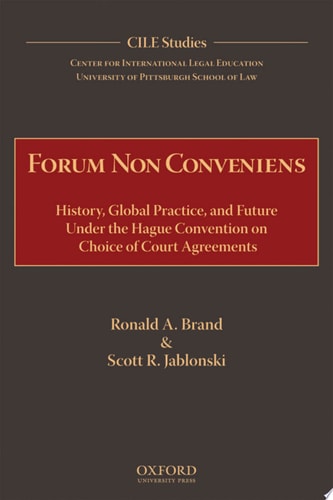
Forum Non Conveniens: History, Global Practice, and Future under the Hague Convention on Choice of Court Agreements
0
0
As an Amazon Associate and affiliate partner, Menrva Books earns from qualifying purchases. Learn more
Author Description
With increased international trade transactions and a corresponding increase in disputes arising from those transactions, the application of the doctrine of Forum Non Conveniens - the discretionary power of a court to decline jurisdiction based on the convenience of the parties and the interests of justice - has become extremely relevant when determining which country's court should preside over a controversy involving nationals of different countries. Forum Non Conveniens: History, Global Practice, and Future Under the Hague Convention on Choice of Court Agreements provides an in-depth analysis of the common law doctrine of Forum Non Conveniens as it has evolved in the four major common law countries (UK, US, Canada, and Australia), and looks at the similarities and differences of the doctrine among those four countries. It compares Forum Non Conveniens to the more rigid analogous doctrine of Lis Alibi Pendens found in civil law countries, which requires automatic deference to the court where a dispute is first filed and explains current initiatives for coordinating jurisdictional issues between the common law and civil law systems, the most important of which is the 2005 Hague Convention on Choice of Court Agreements. The authors explain how the Hague Convention provides a rational approach to the confluence of common law and civil law doctrines and how its application to international transactions is likely to temper judicial application of the doctrine of Forum Non Conveniens and provides greater predictability with respect to enforcement of private party choice of court agreements.Forum Non Conveniens: History, Global Practice, and Future Under the Hague Convention on Choice of Court Agreements is the only book to provide a complete explanation of Forum Non Conveniens in the context of global litigation, making it a very important resource and reference work.
Menrva's Summary
THE THESIS
This work investigates the historical evolution and contemporary application of the doctrine of forum non conveniens within the context of increasing international trade disputes. Ronald A. Brand and Scott R. Jablonski utilize their expertise in international law to analyze how discretionary jurisdictional powers function across major common law jurisdictions. The authors argue that the 2005 Hague Convention on Choice of Court Agreements serves as a necessary framework to reconcile the flexibility of common law doctrines with the rigid requirements of civil law systems, ultimately promoting greater predictability in global litigation.
THE SCOPE MAP
What You Will Find
- Comparative analysis of forum non conveniens in the UK, US, Canada, and Australia.
- Examination of the civil law doctrine of lis alibi pendens and its interaction with common law systems.
- Detailed evaluation of the 2005 Hague Convention on Choice of Court Agreements as a jurisdictional tool.
- Assessment of judicial trends regarding the enforcement of private party choice of court agreements.
THE AUTHORITY PERSPECTIVE
Legal scholars and practitioners identify this text as a primary resource for understanding the intersection of common law and civil law jurisdictional practices. Readers frequently note the academic density of the prose, which provides a comprehensive reference for those navigating complex international litigation frameworks.
Page Count:
358
Publication Date:
2007-07-27
Publisher:
Oxford University Press
ISBN-10:
0195329279
ISBN-13:
9780195329278
Academic
Civil Procedure
Law
International Law
Community Tags
Other Editions(3)

Similar Books









Reader Comments
Share Your Thoughts
No comments yet. Be the first to share your thoughts!