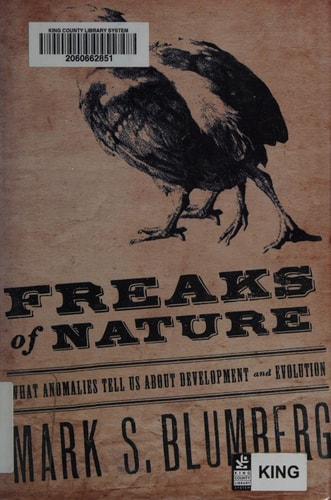
Freaks of Nature: What Anomalies Tell Us about Development and Evolution
0
0
As an Amazon Associate and affiliate partner, Menrva Books earns from qualifying purchases. Learn more
Author Description
In most respects, Abigail and Brittany Hensel are normal American twins. Born and raised in a small town, they enjoy a close relationship, though each has her own tastes and personality. But the Hensels also share a body. Their two heads sit side-by-side on a single torso, with two arms and two legs. They have not only survived, but have developed into athletic, graceful young women. And that, writes Mark S. Blumberg, opens an extraordinary window onto human development and evolution.In Freaks of Nature, Blumberg turns a scientist's eye on the oddities of nature, showing how a subject once relegated to the sideshow can help explain some of the deepest complexities of biology. Why, for example, does a two-headed human so resemble a two-headed minnow? What we need to understand, Blumberg argues, is that anomalies are the natural products of development, and it is through developmental mechanisms that evolution works. Freaks of Nature induces a kind of intellectual vertigo as it upends our intuitive understanding of biology. What really is an anomaly? Why is a limbless human a "freak," but a limbless reptile-a snake-a successful variation?What we see as deformities, Blumberg writes, are merely alternative paths for development, which challenge both the creature itself and our ability to fit it into our familiar categories. Rather than mere dead-ends, many anomalies prove surprisingly survivable--as in the case of the goat without forelimbs that learned to walk upright. Blumberg explains how such variations occur, and points to the success of the Hensel sisters and the goat as examples of the extraordinary flexibility inherent in individual development. In taking seriously a subject that has often been shunned as discomfiting and embarrassing, Mark Blumberg sheds new light on how individuals--and entire species--develop, survive, and evolve.
Menrva's Summary
THE THESIS
This book investigates how biological anomalies serve as critical indicators of the flexibility and mechanisms inherent in development and evolution. Mark S. Blumberg, a professor of psychology and behavioral neuroscience, utilizes case studies of physical variations in humans and animals to argue that anomalies are not mere errors, but natural products of developmental processes. By examining these variations, he posits that evolution operates through the same developmental pathways that produce both standard and non-standard biological outcomes.
THE SCOPE MAP
What You Will Find
- Analysis of developmental biology and the mechanisms of phenotypic variation.
- Comparative studies between human anomalies and similar variations in animal species.
- Examination of the survival strategies and adaptability of organisms with physical deformities.
- A theoretical framework for reclassifying anomalies as alternative developmental paths rather than biological failures.
THE AUTHORITY PERSPECTIVE
Experts and readers alike note that Blumberg provides a highly accessible yet scientifically rigorous look at a traditionally sensitive subject. The text is frequently cited for its ability to bridge the gap between complex developmental theory and observable biological phenomena.
Page Count:
344
Publication Date:
2008-11-13
Publisher:
Oxford University Press
ISBN-10:
0195322827
ISBN-13:
9780195322828
Nature
Science
Biology
Developmental Psychology
Developmental Biology
Monsters
Evolutionary Biology
Community Tags
Similar Books