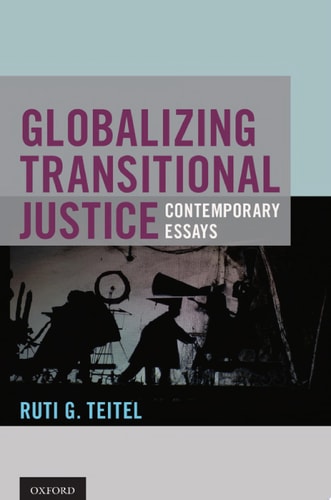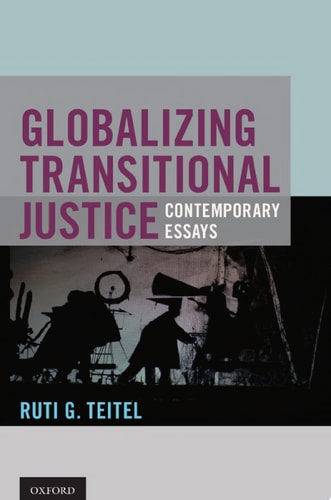
Globalizing Transitional Justice
0
0
As an Amazon Associate and affiliate partner, Menrva Books earns from qualifying purchases. Learn more
Author Description
Among the most prominent and significant political and legal developments since the end of the Cold War is the proliferation of mechanisms for addressing the complex challenges of transition from authoritarian rule to human rights-based democratic constitutionalism, particularly with regards to the demands for accountability in relation to conflicts and abuses of the past. Whether one thinks of the Middle East, South Africa, the Balkans, Latin America, or Cambodia, an extraordinary amount of knowledge has been gained and processes instituted through transitional justice. No longer a byproduct or afterthought, transitional justice is unquestionably the driver of political change. In Globalizing Transitional Justice, Ruti G. Teitel provides a collection of her own essays that embody her evolving reflections on the practice and discourse of transitional justice since her book Transitional Justice published back in 2000. In this new book, Teitel focuses on the ways in which transitional justice concepts have found legal expression, especially through human rights law and jurisprudence, and international criminal law. These essays shed light on some of the difficult choices encountered in the design of transitional justice: criminal trials vs. amnesties, or truth commissions; domestic or international processes; peace and reconciliation vs. accountability and punishment. Transitional justice is considered not only in relation to political events and legal developments, but also in relation to the broader social and cultural tendencies of our times.
Menrva's Summary
THE THESIS
This work investigates how transitional justice has evolved from a localized political response into a globalized legal framework for managing the shift from authoritarianism to democratic constitutionalism. Ruti G. Teitel, a scholar of international law, synthesizes her long-term research and reflections to analyze how human rights jurisprudence and international criminal law now drive political change. The text argues that transitional justice is no longer a peripheral concern but a central mechanism in contemporary global governance.
THE SCOPE MAP
What You Will Find
- Analysis of legal mechanisms including criminal trials, amnesties, and truth commissions.
- Examination of the intersection between domestic legal processes and international human rights law.
- Comparative studies of transitions in regions such as the Middle East, South Africa, the Balkans, Latin America, and Cambodia.
Scope Limits
- The text focuses primarily on legal and political discourse rather than providing a comprehensive historical narrative of every specific regional conflict.
- It does not offer a prescriptive manual for policy implementation but rather a theoretical and analytical framework for understanding existing practices.
THE AUTHORITY PERSPECTIVE
Experts recognize this collection as a significant contribution to the field of international law, noting its depth in connecting theoretical concepts to practical legal developments. Readers frequently highlight the academic density of the prose, which serves as a sophisticated resource for scholars and practitioners of human rights law.
Page Count:
234
Publication Date:
2014-01-01
Publisher:
Oxford University Press
ISBN-10:
0190291133
ISBN-13:
9780190291136
Transitional Justice
Law
Human rights
Professional Career & Trade
International relations
Constitutional Law
Administration of Justice