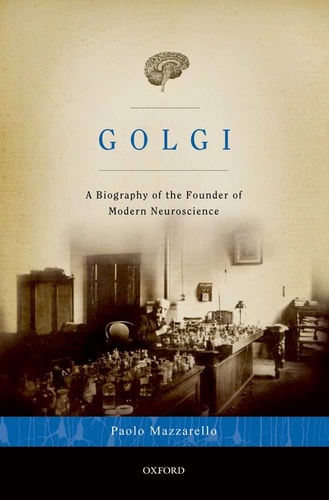
Golgi: A Biography of the Founder of Modern Neuroscience
0
0
As an Amazon Associate and affiliate partner, Menrva Books earns from qualifying purchases. Learn more
Author Description
The life of Camillo Golgi was an extraordinary intellectual adventure in three major fields of biology and medicine, namely neuroscience, emerging cell biology, and the new science of medical microbiology.in 1873, Golgi published the description of a revolutionary histological technique which allowed one, for the first time, to visualize a single nerve cell with all its ramifications, and which could be followed and analyzed even at a great distance from the cell bodies. The so-called "black reaction" (later named the "Golgi method") provided the spark to a truly scientific revolution which allowed the morphology and the basic architecture of the cerebral tissue to be evidenced in all its complexity, thus contributing to the foundation of modern neuroscience. It has been written that, in the same way Galileo Galilei was able to find new stars observing any sky region with his telescope. Golgi was able to find new nervous structures and nerve cells by applying his black reaction to any brain region. Finally, the details of the most complex structure in the known universe, the brain, could be characterized.Golgi's black reaction is just one of his many successes and contributions to society. As this book illustrates, he has also strongly contributed to the development of cell biology with the "internal reticular apparatus" (later called the "Golgi apparatus") and to medical microbiology with his studies on malaria. Engrossing and authoritative, Golgi: A Biography of the Founder of Modern Neuroscience, is a detailed account of one of the most prominent European researchers of his time.
Menrva's Summary
THE THESIS
This biography investigates the life and scientific contributions of Camillo Golgi, the researcher whose histological innovations fundamentally enabled the birth of modern neuroscience. Paolo Mazzarello, a historian of science, synthesizes archival research and scientific records to document Golgi's intellectual trajectory. The text argues that Golgi's development of the 'black reaction' served as a critical instrument for mapping the brain's architecture, comparable to the impact of the telescope on astronomy. The book further examines his broader influence on cell biology and microbiology, specifically his work on the Golgi apparatus and malaria.
THE SCOPE MAP
What You Will Find
- Detailed analysis of the 'black reaction' histological technique and its impact on neuroanatomy.
- Historical context regarding the development of cell biology and the discovery of the internal reticular apparatus.
- Examination of Golgi's clinical research and contributions to the study of malaria.
- A comprehensive overview of the scientific landscape in 19th-century Europe and its influence on medical research.
THE AUTHORITY PERSPECTIVE
Experts recognize this work as a definitive biographical study of a pivotal figure in the history of medicine. Readers frequently note the academic rigor and the clarity with which the author explains complex biological concepts for a general audience.
Page Count:
512
Publication Date:
2009-11-24
Publisher:
Oxford University Press
ISBN-10:
0195337840
ISBN-13:
9780195337846
History
Science
Biography
Neurosciences
Scientists
Histology
Medicine
Nobel prizes
Italy history
Biology
Neuroscience
Physicians biography
Community Tags
Similar Books