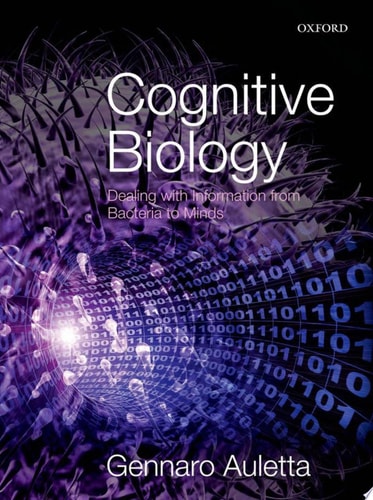
Cognitive Biology: Dealing with Information from Bacteria to Minds
0
0
As an Amazon Associate and affiliate partner, Menrva Books earns from qualifying purchases. Learn more
Author Description
Providing a new conceptual scaffold for further research in biology and cognition, this book introduces the new field of cognitive biology, a systems biology approach showing that further progress in this field will depend on a deep recognition of developmental processes, as well as on the consideration of the developed organism as an agent able to modify and control its surrounding environment. The role of cognition, the means through which the organism is able to cope with its environment, cannot be underestimated. In particular, it is shown that this activity is grounded on a theory of information based on Bayesian probabilities. The organism is considered as a cybernetic system able to integrate a processor as a source of variety (the genetic system), a regulator of its own homeostasis (the metabolic system), and a selecting system separating the self from the non-self (the membrane in unicellular organisms). Any organism is a complex system that can survive only if it is able to maintain its internal order against the spontaneous tendency towards disruption. Therefore, it is forced to monitor and control its environment and so to establish feedback circuits resulting in co-adaptation. Cognitive and biological processes are shown to be inseparable
Menrva's Summary
THE THESIS
This book investigates the foundational question of how cognitive processes function as an essential biological mechanism for organism survival across the evolutionary spectrum. Gennaro Auletta, a scholar in the philosophy of science and biology, constructs a theoretical framework that bridges systems biology with information theory. He argues that cognition is not an exclusive trait of complex brains but a fundamental activity of all living systems, from bacteria to higher-order minds, grounded in Bayesian probability and cybernetic feedback loops.
THE SCOPE MAP
What You Will Find
- A systems biology framework integrating genetic, metabolic, and membrane-based regulatory systems.
- Application of Bayesian probability theory to biological information processing.
- Analysis of co-adaptation and homeostasis as cognitive functions.
Scope Limits
- The text does not provide a comprehensive history of cognitive psychology.
- It does not focus on clinical neurological disorders or human-specific behavioral pathologies.
THE AUTHORITY PERSPECTIVE
Experts recognize this work as a dense, interdisciplinary synthesis that challenges traditional boundaries between biology and cognitive science. Readers frequently note the academic rigor of the prose, which requires a strong background in systems theory to fully grasp the author's proposed conceptual scaffold.
Page Count:
880
Publication Date:
2011-01-01
Publisher:
OUP Oxford
ISBN-10:
0191621811
ISBN-13:
9780191621819
Science
Biology
Cybernetics
Evolutionary Biology
Categories
Kindle Store
Cognitive
Kindle eBooks
Medicine
Community Tags
Similar Books