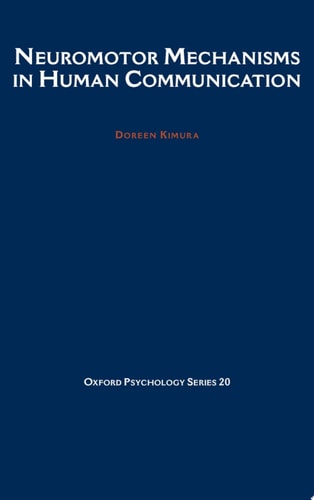
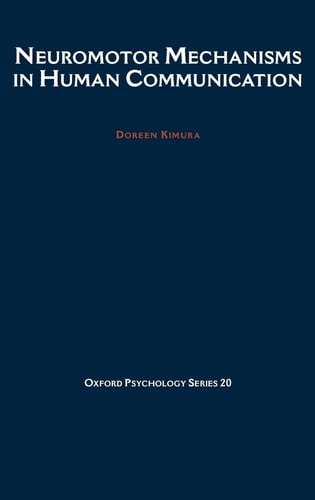
Neuromotor Mechanisms in Human Communication
0
0
As an Amazon Associate and affiliate partner, Menrva Books earns from qualifying purchases. Learn more
Author Description
This Monograph Is Based On 20 Years Of Research With Patients Who Have Experienced Pathology In One Hemisphere Of The Brain. It Deals With Brain Mechanisms In Human Communicative Behavior, And With Related Motor Functions, From A Broadly Biological Point Of View. In So Doing, The Work Discusses The Possible Evolutionary Origins Of Human Communication, The Relation Of Brain Mechanisms In Communicative Behavior To Analogous Nonhuman Behaviors, And The Neural Systems Involved In Various Levels And Kinds Of Communication. In Addition, Noncommunicative Mechanisms Which Parallel Those Used In Communication--such As Manual And Oral Praxis, And Constructional Behavior-- Are Outlined In Detail. Individual Differences In Brain Organization For Such Functions, Related To Hand Preference And Sex, Are Also Explored. Although There Is Extensive Reference To Central Nervous System Pathology, The Emphasis Throughout Is On How The Findings Contribute To Understanding Normal Brain Mechanisms. Much New Data Is Presented Along With The Theoretical Treatment Of Human Communication Which Emphasizes A Behavioral Rather Than A Linguistic Approach. This In Turn Provides Continuity With Nonhuman Primates And Early Hominids. The Work Will Interest Psycholinguists, Cognitive Psychologists, Neurologists, Clinical Neuropsychologists, Speech Pathologists, And Advanced Students In These Fields.
Menrva's Summary
THE THESIS
This work investigates the biological and neural foundations of human communication by examining how motor mechanisms in the brain facilitate both communicative and non-communicative behaviors. Doreen Kimura, a prominent researcher in neuropsychology, synthesizes two decades of clinical data derived from patients with unilateral brain pathology. By prioritizing a behavioral framework over traditional linguistic models, the author argues that human communication evolved from motor systems shared with nonhuman primates and early hominids.
THE SCOPE MAP
What You Will Find
- Analysis of neural systems governing manual and oral praxis alongside constructional behavior.
- Examination of individual differences in brain organization based on sex and hand preference.
- Comparative study of human communicative behavior versus analogous nonhuman primate behaviors.
- Theoretical synthesis of evolutionary biology and clinical neuropsychology regarding brain function.
THE AUTHORITY PERSPECTIVE
Experts recognize this monograph as a foundational text for understanding the motor-based origins of human language and communication. Readers frequently note the technical density of the prose, which serves as a specialized resource for neurologists, speech pathologists, and cognitive psychologists.
Page Count:
208
Publication Date:
1993-01-01
Publisher:
Oxford University Press, Incorporated
ISBN-10:
0195345290
ISBN-13:
9780195345292
Psychology
Efferent pathways
Psychomotor Performance
Biology
Neurology
Brain
Communicative Disorders
Physiology
Neuroscience
Communication
Community Tags
Other Editions(2)
Similar Books