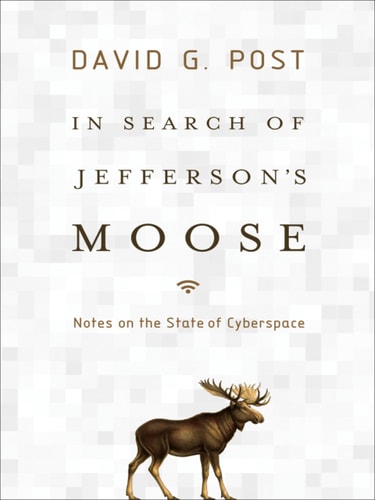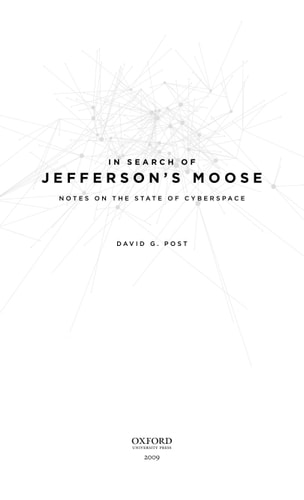
In Search of Jefferson's Moose: Notes on the State of Cyberspace
0
0
As an Amazon Associate and affiliate partner, Menrva Books earns from qualifying purchases. Learn more
Author Description
In 1787, Thomas Jefferson, then the American Minister to France, had the "complete skeleton, skin & horns" of an American moose shipped to him in Paris and mounted in the lobby of his residence as a symbol of the vast possibilities contained in the strange and largely unexplored New World. Taking a cue from Jefferson's efforts, David Post, one of the nation's leading Internet scholars, here presents a pithy, colorful exploration of the still mostly undiscovered territory of cyberspace--what it is, how it works, and how it should be governed.What law should the Internet have, and who should make it? What are we to do, and how are we to think, about online filesharing and copyright law, about Internet pornography and free speech, about controlling spam, and online gambling, and cyberterrorism, and the use of anonymous remailers, or the practice of telemedicine, or the online collection and dissemination of personal information? How can they be controlled? Should they be controlled? And by whom? Post presents the Jeffersonian ideal--small self-governing units, loosely linked together as peers in groups of larger and larger size--as a model for the Internet and for cyberspace community self-governance. Deftly drawing on Jefferson's writings on the New World in Notes on the State of Virginia, Post draws out the many similarities (and differences) between the two terrains, vividly describing how the Internet actually functions from a technological, legal, and social perspective as he uniquely applies Jefferson's views on natural history, law, and governance in the New World to illuminate the complexities of cyberspace.In Search of Jefferson's Moose is a lively, accessible, and remarkably original overview of the Internet and what it holds for the future.
Menrva's Summary
THE THESIS
How can the principles of Jeffersonian governance be applied to the complex, decentralized landscape of modern cyberspace? David G. Post, a prominent scholar in Internet law, utilizes the historical metaphor of Thomas Jefferson’s efforts to catalog the American wilderness to frame the current state of the digital frontier. By examining the intersection of technology, law, and social organization, Post argues for a model of self-governance that mirrors Jefferson’s vision of loosely linked, autonomous communities.
THE SCOPE MAP
What You Will Find
- Analysis of Internet governance models including filesharing, copyright, and free speech regulations.
- Application of Jeffersonian political philosophy to digital architecture and community self-regulation.
- Examination of technical and social challenges such as cyberterrorism, spam, and data privacy.
- Comparative study between the exploration of the New World and the development of the digital landscape.
THE AUTHORITY PERSPECTIVE
Experts and legal scholars frequently cite this work as a foundational text for understanding the early philosophical debates surrounding Internet regulation. Readers often note that the prose remains accessible to non-specialists while providing a rigorous framework for evaluating the future of digital policy.
Page Count:
244
Publication Date:
2009-01-21
Publisher:
Oxford University Press
ISBN-10:
0195342895
ISBN-13:
9780195342895
History
Politics
Computer Networks
Information superhighway
Internet
Governance
Law
Technology