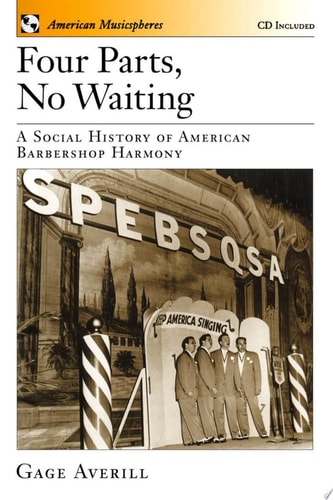
Four Parts, No Waiting: A Social History of American Barbershop Harmony
0
0
As an Amazon Associate and affiliate partner, Menrva Books earns from qualifying purchases. Learn more
Author Description
Four Parts, No Waiting investigates the role that vernacular, barbershop-style close harmony has played in American musical history, in American life, and in the American imagination. Starting with a discussion of the first craze for Austrian four-part close harmony in the 1830s, Averill traces the popularity of this musical form in minstrel shows, black recreational singing, vaudeville, early recordings, and in the barbershop revival of the 1930s. In his exploration of barbershop, Averill uncovers a rich musical tradition--a hybrid of black and white cultural forms, practiced by amateurs, and part of a mythologized vision of small-town American life. Barbershop harmony played a central -- and overlooked -- role in the panorama of American music. Averill demonstrates that the barbershop revival was part of a depression-era neo-Victorian revival, spurred on by insecurities of economic and social change. Contemporary barbershop singing turns this nostalgic vision into lived experience. Arguing that the "old songs" function as repositories of idealized social memory, Averill reveals ideologies of gender, race, and class. This engagingly-written, often funny book critiques the nostalgic myths (especially racial myths) that have surrounded the barbershop revival, but also celebrates the civic-minded, participatory spirit of barbershop harmony.
Menrva's Summary
THE THESIS
This book investigates the role that vernacular, barbershop-style close harmony has played in American musical history, social life, and the national imagination. Gage Averill, an ethnomusicologist, utilizes a historical framework to examine how this musical form evolved from 19th-century influences into a distinct American tradition. He argues that the barbershop revival of the 1930s served as a neo-Victorian response to economic instability, functioning as a repository for idealized social memory and complex ideologies regarding race, gender, and class.
THE SCOPE MAP
What You Will Find
- Historical analysis of barbershop harmony from the 1830s through the 20th-century revival.
- Examination of the intersection between black and white musical traditions in American culture.
- Critique of the nostalgic myths and racial narratives embedded in the barbershop tradition.
- Exploration of the civic-minded and participatory nature of amateur musical performance.
THE AUTHORITY PERSPECTIVE
Scholars and music historians frequently cite this work as a definitive study on the cultural significance of barbershop harmony. Experts highlight the text for its ability to balance rigorous academic analysis with an accessible, engaging examination of American social history.
Page Count:
248
Publication Date:
2003-01-01
Publisher:
Oxford University Press
ISBN-10:
0195353757
ISBN-13:
9780195353754
Music
History
Social History
Musicology
American History
Community Tags
Similar Books