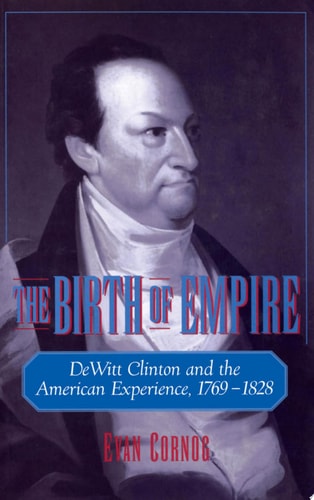
The Birth of Empire: DeWitt Clinton and the American Experience, 1769-1828
0
0
As an Amazon Associate and affiliate partner, Menrva Books earns from qualifying purchases. Learn more
Author Description
DeWitt Clinton (1769-1828) dominated the politics of New York State during the first quarter of the nineteenth century, serving as mayor of New York City and then governor of the state. At the same time, he was influential on the national scene, running for president in 1812 and only narrowly losing to James Madison. Although patrician in his sentiments, Clinton nevertheless developed new forms of party politics, including the spoils system. He was an early champion of the nomination of candidates by convention rather than legislative caucus, and as a United States Senator contributed the draft language for the Twelfth Amendment, which embedded party politics in the fabric of the Constitution.Clinton's greatest achievement was the Erie Canal, the establishment and implementation of which he championed as early as 1810. Construction of the canal began in 1817, and even before it was completed, eight years later, it had brought profound changes--economic, cultural, and social--to the state and the nation. As Evan Cornog illustrates in his detailed and compelling narrative, the Erie Canal hastened the economic expansion of the country, altered its political geography, set an example for activist government, and decisively secured New York City's position as America's foremost metropolis. It was a project unlike anything the Empire State--or the United States--had seen before, and was only the most successful of Clinton's many efforts to implement his view that government should play an active role in the economic and intellectual development of American society.The Birth of Empire chronicles not only the life of an important political leader but the accomplishments that underlay his success. As mayor of New York City, for example, Clinton was instrumental in the founding of the public-school system. He sponsored countless measures to promote cultural enrichment as well as educational opportunities for New Yorkers, and helped to establish and lead such institutions as the New-York Historical Society.
Menrva's Summary
THE THESIS
This work investigates how DeWitt Clinton’s political career and his advocacy for infrastructure projects like the Erie Canal shaped the early development of the American state. Evan Cornog, a scholar of American political history, utilizes primary source documents and historical records to analyze Clinton’s influence on New York and national politics. The book argues that Clinton’s vision of an activist government, which prioritized economic and intellectual development, provided a blueprint for the modern American political experience.
THE SCOPE MAP
What You Will Find
- A detailed examination of New York State politics during the early nineteenth century.
- Analysis of the development of the spoils system and the transition to candidate nomination by convention.
- Historical documentation regarding the construction and economic impact of the Erie Canal.
- An overview of Clinton’s contributions to public education and cultural institutions in New York City.
THE AUTHORITY PERSPECTIVE
Historians and political scholars recognize this text as a definitive account of DeWitt Clinton’s role in shaping early American governance. Readers frequently note the clarity of the prose and the author's ability to connect individual political maneuvers to broader national trends.
Page Count:
240
Publication Date:
2000-01-01
Publisher:
Oxford University Press
ISBN-10:
019535320X
ISBN-13:
9780195353204
History
Biography
Nineteenth century
United States
American History
New York
Community Tags
Similar Books














