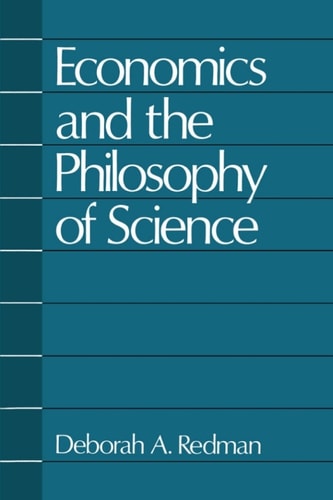
Economics and the Philosophy of Science
0
0
As an Amazon Associate and affiliate partner, Menrva Books earns from qualifying purchases. Learn more
Author Description
Economists and other social scientists in this century have often supported economic arguments by referring to positions taken by philosophers of science. This important new book looks at the reliability of this practice and, in the process, provides economists, social scientists, and historians with the necessary background to discuss methodological matters with authority. Redman first presents an accurate, critical, yet neutral survey of the modern philosophy of science from the Vienna Circle to the present, focusing particularly on logical positivism, sociological explanations of science (Polanyi, Fleck, Kuhn), the Popper family, and the history of science. She then deals with economic methodology in the twentieth century, looking at a wide range of methodological positions, especially those supported by positions from the philosophy of science. She considers the myth of the feasibility of falsification in economics and, within the context of its significance for economics, discusses the interpretation of Kuhn's philosophy of science as consensus and the danger such a view represents to science. Appendices review the history of the is-ought dispute and list economists whose first works deal with methodological topics. Comprehensive, readable, and accessible to those with little background knowledge, Redman's book will appeal to a wide range of social scientists and philosophers of science.
Menrva's Summary
THE THESIS
This book investigates the validity and reliability of economists utilizing philosophical frameworks to justify and structure economic arguments. Deborah A. Redman, an expert in the intersection of economic theory and philosophy, provides a comprehensive survey of twentieth-century scientific thought. She evaluates how various schools of philosophy, including logical positivism and the work of Kuhn and Popper, have been applied to economic methodology. The text serves as a critical bridge for social scientists seeking to understand the historical and logical foundations of their own disciplinary practices.
THE SCOPE MAP
What You Will Find
- A historical survey of the philosophy of science from the Vienna Circle to contemporary perspectives.
- Critical analysis of logical positivism, sociological explanations of science, and the Popperian school.
- Examination of the feasibility of falsification within economic models.
- Appendices detailing the history of the is-ought dispute and a bibliography of early methodological works by economists.
THE AUTHORITY PERSPECTIVE
Experts recognize this work as a foundational text for those seeking to bridge the gap between economic theory and scientific philosophy. Readers frequently note the accessibility of the prose, which allows those with limited philosophical backgrounds to engage with complex methodological debates.
Page Count:
270
Publication Date:
1993-01-01
Publisher:
Oxford University Press
ISBN-10:
0195359526
ISBN-13:
9780195359527
Philosophy
Economics
Methodology
Science
Macroeconomic Theory
Social Science
Community Tags
Similar Books