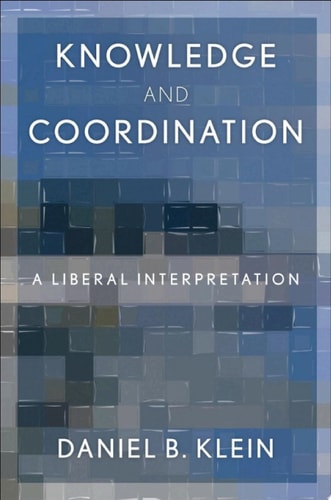
Knowledge and Coordination: A Liberal Interpretation
0
0
As an Amazon Associate and affiliate partner, Menrva Books earns from qualifying purchases. Learn more
Author Description
Adam Smith and Friedrich Hayek saw the liberty principle as focal and accorded it strong presumption, but their wisdom invokes how little we can know. In Knowledge and Coordination, Daniel Klein re-examines the elements of economic liberalism. He interprets Hayek's notion of spontaneous order from the aestheticized perspective of a Smithian spectator, real or imagined. Klein addresses issues economists have had surrounding the notion of coordination by distinguishing the concatenate coordination of Hayek, Ronald Coase, and Michael Polanyi from the mutual coordination of Thomas Schelling and game theory. Clarifying the meaning of cooperation, he resolves debates over whether entrepreneurial innovation enhances or upsets coordination, and thus interprets entrepreneurship in terms of discovery or new knowledge. Beyond information, knowledge entails interpretation and judgment, emergent from tacit reaches of the "society of mind," itself embedded in actual society. Rejecting homo economicus in favor of the "deepself," Klein offers a distinctive formulation of knowledge economics, entailing asymmetric interpretation, judgment, entrepreneurship, error, and correction-and kinds of discovery-which all serve the cause of liberty. This richness of knowledge joins agent and analyst, and meaningful theory depends on tacit affinities between the two. Knowledge and Coordination highlights the recurring connections to underlying purposes and sensibilities, of analysts as well as agents. Behind economic talk of market communication and social error and correction lies Klein's Smithian allegory, with the allegorical spectator representing a conception of the social. Knowledge and Coordination instructs us to declare such allegory. Knowledge and Coordination is an authoritative take on how, by confessing the looseness of its judgments and the by-and-large status of its claims, laissez-faire liberalism makes its economic doctrines more robust and its presumption of liberty more viable
Menrva's Summary
THE THESIS
This book investigates the foundational relationship between the limits of human knowledge and the justification for economic liberalism. Daniel B. Klein, a professor of economics and a scholar of classical liberal thought, synthesizes the work of Adam Smith and Friedrich Hayek to construct a framework for understanding social coordination. He argues that economic liberalism is strengthened, rather than weakened, by acknowledging the inherent subjectivity and tacit nature of human knowledge and judgment.
THE SCOPE MAP
What You Will Find
- A comparative analysis of concatenate coordination versus mutual coordination frameworks.
- A re-evaluation of entrepreneurship as a process of discovery and interpretation rather than mere information processing.
- The introduction of the "deepself" model to replace the traditional homo economicus construct.
- An exploration of the "Smithian spectator" as an allegorical device for understanding social order.
Scope Limits
- The text does not provide empirical econometric modeling or quantitative data sets.
- It does not address contemporary macroeconomic policy or central banking mechanics.
THE AUTHORITY PERSPECTIVE
Scholars of Austrian economics and political philosophy frequently cite this work for its sophisticated integration of Smithian moral philosophy with Hayekian spontaneous order. Readers often note the academic density of the prose, which requires a strong background in economic theory and the history of liberal thought to fully grasp the author's nuanced arguments.
Page Count:
376
Publication Date:
2012-01-01
Publisher:
Oxford University Press
ISBN-10:
0190208309
ISBN-13:
9780190208301
Philosophy
Economics
Political Philosophy
Economic Theory
Liberalism
Macroeconomic Theory
Social Science
Community Tags
Similar Books