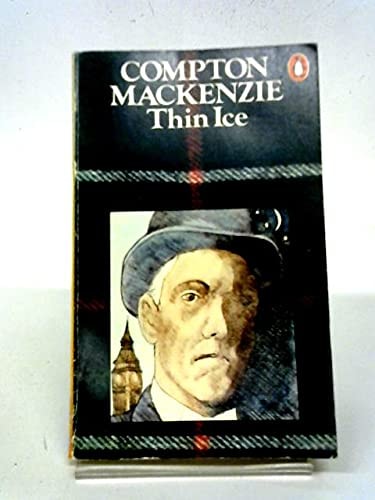
Thin Ice
0
0
As an Amazon Associate and affiliate partner, Menrva Books earns from qualifying purchases. Learn more
Author Description
Perhaps it was strange that George Gaymer should have become a friend of Henry Fortescue at Oxford in the last years of the 19th century. Politically they were poles apart. Henry, already President of the Union, had a brilliant future before him; George was good hearted but mediocre. Above all, Henry was a homosexual; George was not. Yet George's loyal friendship stood many tests across more than forty years, and was reliable when that of Henry's own kind proved transitory or even treacherous. Absorbed in Eastern politics and Empire problems, Henry suppressed his homosexual inclinations. Regarding discretion as impossible, he chose complete self-denial, for he had no intention, as he once confided to George, of walking about on thin ice. Thus, for years after he got into Parliament, he was caution incarnate. But his failure to gain Cabinet office was so bitter a disappointment that, in search of some anodyne, he was tempted to throw discretion to the winds. As the scene changes from London to Morocco, from Hampshire to Kenya, and then to the Seychelles and Somerset, we follow the course of Henry's life through the perplexed, often apprehensive, eyes of George Gaymer. And we cannot but admire Compton Mackenzie's extraordinarily delicate handling of his theme, the skill with which he evokes the passage of eventful years and maintains suspense to the very end. Seldom have his outstanding gifts as a novelist been displayed to such advantage.
Menrva's Summary
THE PULSE
Henry Fortescue, a rising political star, struggles to maintain a facade of conventionality while suppressing his homosexual identity in the rigid social climate of early 20th-century Britain. George Gaymer, a steadfast and unassuming friend, serves as the observer to Henry's life, witnessing the internal and external pressures that define his career. As Henry navigates the complexities of Parliament and the expectations of the British Empire, he faces the constant threat of scandal that could dismantle his ambitions. The narrative unfolds through George's perspective, tracking their relationship across decades and various international settings as Henry attempts to balance his public duty with his private reality.
INSIDE THE PAGES
- First-person observational narrative framework
- Exploration of political ambition and social reputation
- Multi-decade chronological progression
- International settings including London, Morocco, and Kenya
- Focus on the dynamics of long-term male friendship
- Examination of self-denial and personal integrity
- Subtle character development through external observation
- Atmospheric depiction of British social and political life
THE COLLECTIVE ECHO
Readers and critics frequently note the author's restrained and delicate approach to a sensitive subject matter. Discussion often centers on the effectiveness of George Gaymer as a narrator, providing a grounded perspective on Henry's more complex and often elusive personality. The pacing is described as deliberate, mirroring the slow accumulation of years and the gradual erosion of Henry's carefully constructed defenses. Many highlight the skill with which the narrative captures the shifting social mores of the early 20th century without resorting to melodrama. The book is often cited for its nuanced portrayal of loyalty and the quiet tragedy of a life lived in the shadows of public expectation.
Page Count:
192
Publication Date:
1977-01-01
Publisher:
Penguin Books
ISBN-10:
0140013695
ISBN-13:
9780140013696
Historical Fiction
Classic Literature
Political fiction
LGBTQ
British literature
Community Tags
Similar Books