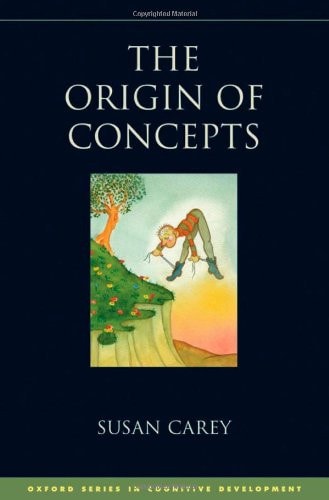
The Origin of Concepts
0
0
As an Amazon Associate and affiliate partner, Menrva Books earns from qualifying purchases. Learn more
Author Description
Only human beings have a rich conceptual repertoire with concepts like tort, entropy, Abelian group, mannerism, icon and deconstruction. How have humans constructed these concepts? And once they have been constructed by adults, how do children acquire them? While primarily focusing on the second question, in The Origin of Concepts, Susan Carey shows that the answers to both overlap substantially.Carey begins by characterizing the innate starting point for conceptual development, namely systems of core cognition. Representations of core cognition are the output of dedicated input analyzers, as with perceptual representations, but these core representations differ from perceptual representations in having more abstract contents and richer functional roles. Carey argues that the key to understanding cognitive development lies in recognizing conceptual discontinuities in which new representational systems emerge that have more expressive power than core cognition and are also incommensurate with core cognition and other earlier representational systems. Finally, Carey fleshes out Quinian bootstrapping, a learning mechanism that has been repeatedly sketched in the literature on the history and philosophy of science. She demonstrates that Quinian bootstrapping is a major mechanism in the construction of new representational resources over the course of childrens cognitive development.Carey shows how developmental cognitive science resolves aspects of long-standing philosophical debates about the existence, nature, content, and format of innate knowledge. She also shows that understanding the processes of conceptual development in children illuminates the historical process by which concepts are constructed, and transforms the way we think about philosophical problems about the nature of concepts and the relations between language and thought.
Menrva's Summary
THE THESIS
This work investigates the mechanisms by which human beings construct complex conceptual repertoires and how children acquire these concepts over time. Susan Carey, a prominent researcher in cognitive development, synthesizes developmental data with philosophical inquiry to argue that conceptual growth is not merely additive. She posits that children undergo conceptual discontinuities, moving from innate systems of core cognition to more expressive representational systems through a process she identifies as Quinian bootstrapping.
THE SCOPE MAP
What You Will Find
- Analysis of core cognition as the innate starting point for human conceptual development.
- Examination of the Quinian bootstrapping mechanism as a driver for representational change.
- Comparison between historical scientific discovery and individual cognitive development in children.
- Discussion on the relationship between language, thought, and the nature of abstract concepts.
THE AUTHORITY PERSPECTIVE
Experts recognize this text as a foundational contribution to the field of cognitive development, particularly for its bridge between developmental psychology and the philosophy of science. Readers frequently note the academic density of the prose, which is intended for scholars and advanced students of cognitive science.
Page Count:
608
Publication Date:
2009-05-06
Publisher:
Oxford University Press
ISBN-10:
0195367634
ISBN-13:
9780195367638
Psychology
Epistemology
Concepts
Community Tags
Other Editions(3)

Similar Books














Reader Comments
Share Your Thoughts
No comments yet. Be the first to share your thoughts!