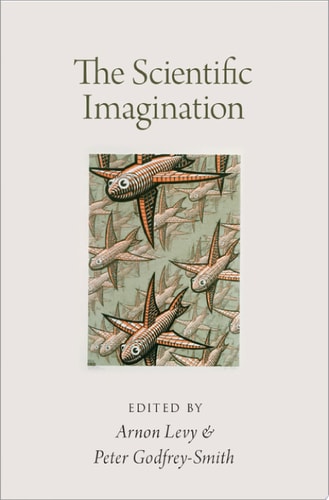
The Scientific Imagination
0
0
As an Amazon Associate and affiliate partner, Menrva Books earns from qualifying purchases. Learn more
Author Description
The imagination, our capacity to entertain thoughts and ideas "in the mind's eye," is indispensable in science as elsewhere in human life. Indeed, common scientific practices such as modeling and idealization rely on the imagination to construct simplified, stylized scenarios essential for scientific understanding. Yet the philosophy of science has traditionally shied away from according an important role to the imagination, wary of psychologizing fundamental scientific concepts like explanation and justification. In recent years, however, advances in thinking about creativity and fiction, and their relation to theorizing and understanding, have prompted a move away from older philosophical perspectives and toward a greater acknowledgement of the place of the imagination in scientific practice. Meanwhile, psychologists have engaged in significant experimental work on the role of the imagination in causal thinking and probabilistic reasoning.The Scientific Imagination delves into this burgeoning area of debate at the intersection of the philosophy and practice of science, bringing together the work of leading researchers in philosophy and psychology. Philosophers discuss such topics as modeling, idealization, metaphor and explanation, examining their role within science as well as how they affect questions in metaphysics, epistemology and philosophy of language. Psychologists discuss how our imaginative capacities develop and how they work, their relationships with processes of reasoning, and how they compare to related capacities, such as categorization and counterfactual thinking. Together, these contributions combine to provide a comprehensive and exciting picture of the scientific imagination.
Menrva's Summary
THE THESIS
This volume investigates the fundamental role of the imagination in scientific practice, challenging the traditional philosophical reluctance to integrate psychological processes into the study of scientific explanation and justification. The editors, Arnon Levy and Peter Godfrey-Smith, compile a series of essays from leading researchers in philosophy and psychology to bridge the gap between abstract theorizing and cognitive reality. By examining how scientists utilize modeling, idealization, and counterfactual thinking, the contributors argue that imaginative capacity is not merely a peripheral human trait but a central component of scientific understanding.
THE SCOPE MAP
What You Will Find
- Philosophical analysis of modeling, idealization, metaphor, and explanation.
- Psychological research on the development of imaginative capacities and their link to causal reasoning.
- Interdisciplinary synthesis of metaphysics, epistemology, and the philosophy of language.
- Experimental data regarding probabilistic reasoning and counterfactual thought processes.
Scope Limits
- The text does not provide a historical survey of scientific discovery.
- It does not offer practical guides for enhancing individual scientific creativity.
THE AUTHORITY PERSPECTIVE
Experts identify this collection as a significant contribution to the intersection of cognitive science and the philosophy of science. Readers frequently note the academic density of the prose, which is intended for scholars and advanced students in these respective fields.
Page Count:
358
Publication Date:
2019-01-01
Publisher:
Oxford University Press
ISBN-10:
0190082674
ISBN-13:
9780190082673
Philosophy
Psychology
Mind & Body
Metaphysics
Epistemology
Philosophy of
Creative ability
Imagination
Community Tags
Similar Books