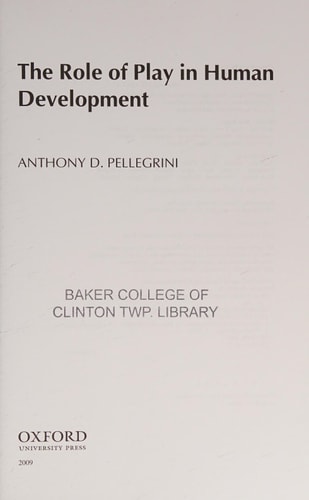
The Role of Play in Human Development
0
0
As an Amazon Associate and affiliate partner, Menrva Books earns from qualifying purchases. Learn more
Author Description
While the subject of play may seem trivial for behavioral science, E.O. Wilson noted that understanding the significance of play is an important challenge facing scholars in these fields. Play is observed among juveniles across a number of animal species and is especially prevalent in young mammals, yet it is difficult to define or to attribute functional significance to it. In this book, Pellegrini argues that play is an excellent example of the ways in which biology and culture influence each other, especially during childhood. Specifically, the innovative possibilities associated with different forms of play behavior during the juvenile period can influence individuals' skill acquisition, and possibly influence the development of the species. In order to understand play in this broad sense, it is necessary to understand its phylogenetic development (across monkeys, great apes, and humans), its place within human development, and its function(s) and atecedents. Such an understanding of the role of play in childhood has implications for a deeper understanding of the role of development in the human experience.This book is unique among its competitors in that it takes an explicitly theoretical orientation as it is applied to human play, in an evolutionary context. This will be the only volume to provide a coherent theoretical framework addressing the role of play in development. In his concluding chapter, Pellegrini will synthesize his arguments and theory, and speculate about directions for future research in the area. Because of these two aspects, this book has the potential to be a highly influential book for scholars in developmental psychology, educational psychology, evolutionary biology, and play theorists in anthropology.
Menrva's Summary
THE THESIS
This book investigates the evolutionary and developmental function of play, challenging the notion that such behavior is trivial by positioning it as a critical mechanism for skill acquisition and species development. Anthony D. Pellegrini, a scholar in developmental psychology, utilizes an evolutionary framework to analyze how biological and cultural factors intersect during childhood. By examining play across various species, including primates and humans, the author constructs a theoretical model that explains the phylogenetic origins and functional significance of juvenile play behaviors. The text serves as a comprehensive synthesis of current research, aiming to provide a unified perspective for scholars across multiple behavioral science disciplines.
THE SCOPE MAP
What You Will Find
- Phylogenetic analysis of play behavior across monkeys, great apes, and humans.
- Theoretical framework linking biological predispositions with cultural influences on juvenile development.
- Examination of the functional significance of play in skill acquisition and cognitive growth.
- Synthesis of evolutionary biology and developmental psychology to predict future research trajectories.
THE AUTHORITY PERSPECTIVE
Experts recognize this work as a foundational theoretical text that bridges the gap between evolutionary biology and developmental psychology. Scholars frequently note the academic density of the prose, which is intended for researchers and advanced students in the behavioral sciences.
Page Count:
278
Publication Date:
2009-08-12
Publisher:
Oxford University Press
ISBN-10:
0195367324
ISBN-13:
9780195367324
Psychology
Psychological aspects
Anthropology
Evolutionary Biology
Developmental Psychology
Education
Community Tags
Similar Books