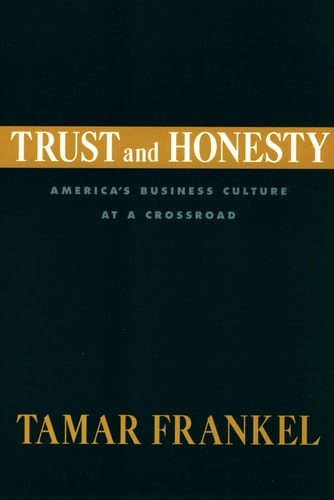
Trust and Honesty: America's Business Culture at a Crossroad
0
0
As an Amazon Associate and affiliate partner, Menrva Books earns from qualifying purchases. Learn more
Author Description
America's culture is moving in a new and dangerous direction, as it becomes more accepting and tolerant of dishonesty and financial abuse. Tamar Frankel argues that this phenomenon is not new; in fact it has a specific traceable past. During the past thirty years temptations and opportunities to defraud have risen; legal, moral and theoretical barriers to abuse of trust have fallen. She goes on to suggest that fraud and the abuse of trust could have a widespread impact on American economy and prosperity, and argues that the way to counter this disturbing trend is to reverse the culture of business dishonesty. Finally, she presents the following thesis: If Americans have had enough of financial abuse, they can demand of their leaders, of themselves, and of each other more honesty and trust and less cynicism. Americans can reject the actions, attitudes, theories and assumptions that brought us the corporate scandals of the 1990s. Though American society can have "bad apples," and its constituents hold differing opinions about the precise meaning of trust and truth, it can remain honest, as long as it aspires to honesty.
Menrva's Summary
THE THESIS
This book investigates the systemic erosion of trust and honesty within American business culture and proposes a societal shift toward ethical accountability to prevent further economic decline. Tamar Frankel, a professor of law, utilizes historical analysis and legal theory to examine how the barriers against financial abuse have diminished over the last three decades. She argues that the normalization of dishonesty in corporate environments poses a direct threat to national prosperity. The text concludes by asserting that a collective demand for integrity from both leaders and citizens is the only mechanism capable of reversing these damaging trends.
THE SCOPE MAP
What You Will Find
- Historical analysis of the decline in moral and legal barriers against financial fraud.
- Examination of corporate scandals from the 1990s as case studies for systemic failure.
- Theoretical framework regarding the definition and necessity of trust in a market economy.
- Proposed strategies for individual and collective action to restore ethical standards in business.
THE AUTHORITY PERSPECTIVE
Experts recognize this work as a significant contribution to the study of business ethics and the intersection of law and culture. Readers frequently note the academic rigor of the author's arguments and the clarity with which she connects historical trends to contemporary economic challenges.
Page Count:
264
Publication Date:
2008-08-11
Publisher:
Oxford University Press
ISBN-10:
0195371704
ISBN-13:
9780195371703
Economics
Business
United States
Ethics
Sociology
Corporations
Fraud
Corporations corrupt practices
Business Law
Finance
Business Ethics
Corporate governance
Community Tags
Similar Books