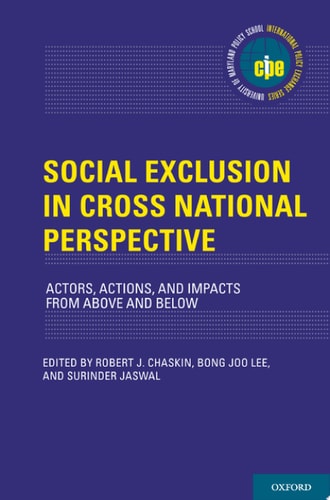
Social Exclusion in Cross-National Perspective: Actors, Actions, and Impacts from Above and Below
0
0
As an Amazon Associate and affiliate partner, Menrva Books earns from qualifying purchases. Learn more
Author Description
Global processes have an increasing influence on local contexts and the nature and distribution of opportunities among populations across the globe. While capital and population mobility, advances in information and communications technology, and economic liberalization have fostered economic development, industrialization, and wealth for some, they have also engendered growing inequalities in income, prosperity, well-being, and access. Those left behind by these global transformations often experience not only material deprivation, but broader dislocation from the contexts, institutions, and capabilities that provide access to social and economic opportunity. The concept of "social exclusion" has been widely adopted to describe the conditions of economic, social, political, and/or cultural marginalization experienced by particular groups of people due to extreme poverty, discrimination, dislocation, and disenfranchisement.This book explores the dynamics of social exclusion within the context of globalization across four countries--China, India, South Korea, and the United States. In particular, it examines how social exclusion is defined, manifested, and responded to with regard to diverse social arenas and processes, varying mechanisms and scales, and a range of impacted populations. Based on collaborative research activities and in-depth deliberation among leading scholars from major academic institutions in each of the four aforementioned countries, the volume provides a rich account of the interplay between globalization and social exclusion, while highlighting the ways in which responses may be more or less effective in different contexts. Its insights will be of particular interest to academics, researchers, and students across diverse social science disciplines.
Menrva's Summary
THE THESIS
This volume investigates how global economic and social transformations contribute to the marginalization of specific populations across diverse national contexts. The authors, a collaborative group of leading scholars from China, India, South Korea, and the United States, utilize a comparative framework to analyze the mechanisms of social exclusion. They argue that while globalization fosters development, it simultaneously creates systemic barriers that prevent vulnerable groups from accessing essential social and economic institutions.
THE SCOPE MAP
What You Will Find
- Comparative analysis of social exclusion in China, India, South Korea, and the United States
- Examination of the interplay between global capital mobility and local institutional access
- Evaluation of policy responses to marginalization across different political systems
Scope Limits
- The text focuses primarily on the four specified nations and does not provide a comprehensive global survey of all developing economies
- The analysis prioritizes structural and institutional factors over individual-level psychological outcomes
THE AUTHORITY PERSPECTIVE
Experts identify this work as a significant contribution to the comparative study of social policy and international development. Scholars frequently note the academic rigor of the cross-national research design and its utility for students and researchers in the social sciences.
Page Count:
368
Publication Date:
2019-01-01
Publisher:
Oxford University Press
ISBN-10:
0190873795
ISBN-13:
9780190873790
Economics
International relations
Sociology
Public Policy
Globalization
Social policy
Community Tags
Other Editions(2)
Similar Books







Reader Comments
Share Your Thoughts
No comments yet. Be the first to share your thoughts!