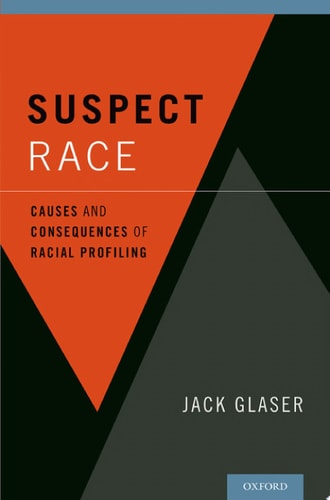
Suspect Race: Causes and Consequences of Racial Profiling
0
0
As an Amazon Associate and affiliate partner, Menrva Books earns from qualifying purchases. Learn more
Author Description
Until now, most discussion of racial profiling has given only fleeting consideration of its causes. Those causes are overwhelmingly psychological. In Suspect Race, social psychologist and public policy expert Jack Glaser leverages a century's worth of social psychological research to provide a clear understanding of how stereotypes, even those operating outside of conscious awareness or control, can cause police to make discriminatory judgments and decisions about who to suspect, stop, question, search, use force on, and arrest. Glaser argues that stereotyping, even nonconscious stereotyping, is a completely normal human mental process, but that it leads to undesirable discriminatory outcomes. Police officers are normal human beings with normal cognition. They are therefore influenced by racial stereotypes that have long connected minorities with aggression and crime. Efforts to merely prohibit racial profiling are inadequate. Additionally, Glaser finds evidence that racial profiling can actually increase crime, and he considers the implications for racial profiling in counterterrorism, finding some similarities and some interesting differences with drug war profiling. Finally, he examines the policy landscape on which racial profiling resides and calls for improved data collection and supervision, reduced discretion, and increased accountability.Drawing on criminology, history, psychological science, and legal and policy analysis, Glaser offers a broad and deep assessment of the causes and consequence of racial profiling. Suspect Race brings to bear the vast scientific literature on intergroup stereotyping to offer the first in-depth and accessible understanding of the primary cause of racial profiling, and to explore implications for policy.
Menrva's Summary
THE THESIS
This book investigates the psychological mechanisms behind racial profiling to determine why discriminatory policing persists despite efforts to prohibit it. Jack Glaser, a social psychologist and public policy expert, synthesizes a century of research to argue that racial profiling is rooted in normal human cognitive processes, specifically the nonconscious application of stereotypes. By examining the intersection of police discretion and implicit bias, Glaser provides a framework for understanding how these mental shortcuts lead to systemic discriminatory outcomes in law enforcement. He concludes by proposing policy reforms focused on data collection, supervision, and accountability to mitigate these effects.
THE SCOPE MAP
What You Will Find
- Analysis of the psychological foundations of stereotyping and implicit bias in law enforcement.
- Examination of the relationship between racial profiling and crime rates.
- Comparative study of profiling practices in the drug war versus counterterrorism efforts.
- Policy recommendations for reducing officer discretion and increasing institutional accountability.
THE AUTHORITY PERSPECTIVE
Experts and scholars in criminology and social psychology recognize this work as a foundational text for understanding the cognitive roots of discriminatory policing. Readers frequently note the academic rigor of the prose, which effectively bridges the gap between complex psychological theory and practical public policy application.
Page Count:
280
Publication Date:
2014-12-05
Publisher:
Oxford University Press
ISBN-10:
0195370406
ISBN-13:
9780195370409
Psychology
Social Science
United States
Public Policy
Criminology
Sociology
Law
Community Tags
Similar Books