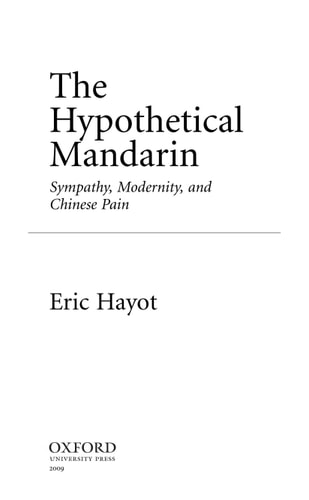
The Hypothetical Mandarin: Sympathy, Modernity, and Chinese Pain
0
0
As an Amazon Associate and affiliate partner, Menrva Books earns from qualifying purchases. Learn more
Author Description
Why has the West for so long and in so many different ways expressed the idea that the Chinese have a special relationship to cruelty and to physical pain? What can the history of that idea and its expressions teach us about the politics of the West's contemporary relation to China? And what does it tell us about the philosophy of modernity?The Hypothetical Mandarin is, in some sense, a history of the Western imagination. It is also a history of the interactions between Enlightenment philosophy, of globalization, of human rights, and of the idea of the modern. Beginning with Bianchon and Rastignac's discussion of whether the former would, if he could, obtain a European fortune by killing a Chinese mandarin in Balzac's Le Pere Goriot (1835), the book traces a series of literary and historical examples in which Chinese life and European sympathy seem to hang in one another's balance. Hayots wide-ranging discussion draws on accounts of torture, on medical case studies, travelers tales, photographs, plasticized corpses, polemical broadsides, watercolors, and on oil paintings. His analyses show that the historical connection between sympathy and humanity, and indeed between sympathy and reality, has tended to refract with a remarkable frequency through the lens called "China," and why the story of the West's Chinese pain goes to the heart of the relation between language and the body and the social experience of the modern human being.Written in an ebullient prose, The Hypothetical Mandarin demonstrates how the network that intertwines China, sympathy, and modernity continues to shape the economic and human experience.
Menrva's Summary
THE THESIS
This book investigates why Western discourse has historically associated the Chinese people with a unique susceptibility to physical pain and how this perception informs contemporary political and philosophical understandings of modernity. Eric Hayot, a scholar of comparative literature and modernism, utilizes a wide array of historical and literary evidence to argue that the Western concept of 'sympathy' is inextricably linked to the construction of 'China' as an object of observation. By examining the intersection of Enlightenment philosophy, human rights discourse, and global history, the author demonstrates how these perceptions of Chinese suffering have shaped the Western definition of the modern human subject.
THE SCOPE MAP
What You Will Find
- A historical analysis of Western literary and cultural representations of China from the 19th century to the present.
- An examination of diverse media including medical case studies, photography, oil paintings, and polemical broadsides.
- A critical framework connecting the philosophy of sympathy to the development of global human rights discourse.
- An exploration of the relationship between language, the physical body, and the social experience of modernity.
THE AUTHORITY PERSPECTIVE
Scholars and critics frequently note the intellectual rigor and interdisciplinary breadth of Hayot's analysis, which bridges literary theory and historical inquiry. The text is recognized as a significant contribution to the study of how cultural perceptions of the 'other' influence the development of Western political and philosophical frameworks.
Page Count:
296
Publication Date:
2009-04-24
Publisher:
Oxford University Press
ISBN-10:
0195377966
ISBN-13:
9780195377965
Philosophy
History
Sympathy
Literary Criticism
Asian Studies
Modernism
Community Tags
Similar Books