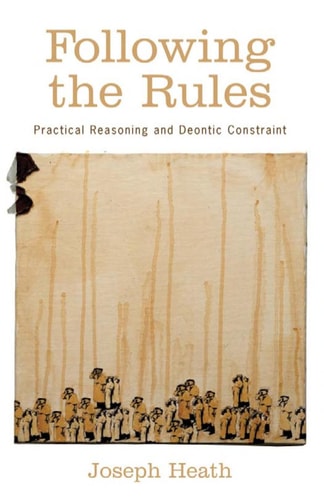
Following the Rules: Practical Reasoning and Deontic Constraint
0
0
As an Amazon Associate and affiliate partner, Menrva Books earns from qualifying purchases. Learn more
Author Description
For centuries, philosophers have been puzzled by the fact that people often respect moral obligations as a matter of principle, setting aside considerations of self-interest. In more recent years, social scientists have been puzzled by the more general phenomenon of rule-following, the fact that people often abide by social norms even when doing so produces undesirable consequences. Experimental game theorists have demonstrated conclusively that the old-fashioned picture of "economic man," constantly reoptimizing in order to maximize utility in all circumstances, cannot provide adequate foundations for a general theory of rational action. The dominant response, however, has been a slide toward irrationalism. If people are ignoring the consequences of their actions, it is claimed, it must be because they are making some sort of a mistake.In Following the Rules, Joseph Heath attempts to reverse this trend, by showing how rule-following can be understood as an essential element of rational action. The first step involves showing how rational choice theory can be modified to incorporate deontic constraint as a feature of rational deliberation. The second involves disarming the suspicion that there is something mysterious or irrational about the psychological states underlying rule-following. According to Heath, human rationality is a by-product of the so-called "language upgrade" that we receive as a consequence of the development of specific social practices. As a result, certain constitutive features of our social environment-such as the rule-governed structure of social life-migrate inwards, and become constitutive features of our psychological faculties. This in turn explains why there is an indissoluble bond between practical rationality and deontic constraint.In the end, what Heath offers is a naturalistic, evolutionary argument in favor of the traditional Kantian view that there is an internal connection between being a rational agent and feeling the force of one
Menrva's Summary
THE THESIS
This book investigates whether rule-following behavior can be reconciled with rational action, challenging the assumption that adhering to social norms is inherently irrational. Joseph Heath, a professor of philosophy and public policy, utilizes insights from game theory, evolutionary biology, and cognitive science to argue that deontic constraints are not mere errors in judgment but are foundational to human rationality. He proposes that the social environment, through language and practice, shapes our internal psychological faculties, thereby linking practical reasoning with the capacity to follow rules.
THE SCOPE MAP
What You Will Find
- A critique of the traditional economic man model in rational choice theory.
- An analysis of the psychological mechanisms underlying norm-governed behavior.
- A synthesis of Kantian ethics with naturalistic and evolutionary frameworks.
- An exploration of how social structures become internalized as cognitive faculties.
THE AUTHORITY PERSPECTIVE
Scholars and students of philosophy frequently cite this work for its rigorous attempt to bridge the gap between formal rational choice theory and the reality of social norm adherence. Readers often note the academic density of the prose, which requires a strong background in analytical philosophy to fully grasp the author's complex arguments.
Page Count:
352
Publication Date:
2008-10-16
Publisher:
Oxford University Press
ISBN-10:
0195370295
ISBN-13:
9780195370294
Philosophy
Social Science
Ethics
Duty
Rational choice theory
Community Tags
Similar Books