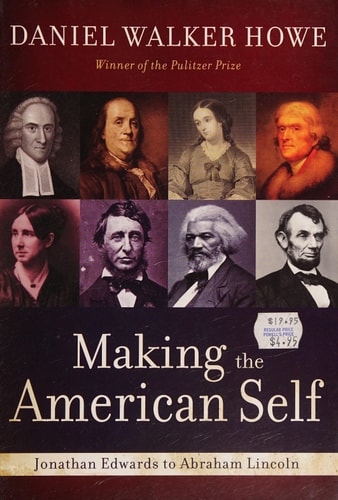
Making the American Self: Jonathan Edwards to Abraham Lincoln
0
0
As an Amazon Associate and affiliate partner, Menrva Books earns from qualifying purchases. Learn more
Author Description
Originally published in 1997 and now back in print, Making the American Self by Daniel Walker Howe, the Pulitzer Prize-winning author of What Hath God Wrought, charts the genesis and fascinating trajectory of a central idea in American history.One of the most precious liberties Americans have always cherished is the ability to "make something of themselves"--to choose not only an occupation but an identity. Examining works by Benjamin Franklin, Jonathan Edwards, Abraham Lincoln, Frederick Douglass, Henry David Thoreau, Ralph Waldo Emerson, Margaret Fuller, and others, Howe investigates how Americans in the 18th and 19th centuries engaged in the process of "self-construction," "self-improvement," and the "pursuit of happiness." He explores as well how Americans understood individual identity in relation to the larger body politic, and argues that the conscious construction of the autonomous self was in fact essential to American democracy--that it both shaped and was in turn shaped by American democratic institutions. "The thinkers described in this book," Howe writes, "believed that, to the extent individuals exercised self-control, they were making free institutions--liberal, republican, and democratic--possible." And as the scope of American democracy widened so too did the practice of self-construction, moving beyond the preserve of elite white males to potentially all Americans. Howe concludes that the time has come to ground our democracy once again in habits of personal responsibility, civility, and self-discipline esteemed by some of America's most important thinkers.Erudite, beautifully written, and more pertinent than ever as we enter a new era of individual and governmental responsibility, Making the American Self illuminates an impulse at the very heart of the American experience.
Menrva's Summary
THE THESIS
This work investigates how the concept of self-construction and personal identity became a foundational pillar of American democratic institutions between the 18th and 19th centuries. Daniel Walker Howe, a Pulitzer Prize-winning historian, utilizes a biographical and philosophical framework to analyze the writings of influential American figures. He argues that the pursuit of self-improvement and individual autonomy was not merely a personal endeavor but a civic necessity that enabled the development of liberal and republican governance. By examining the intersection of private character and public duty, Howe demonstrates how the American identity was consciously forged through discipline and moral responsibility.
THE SCOPE MAP
What You Will Find
- An analysis of intellectual history spanning from the 18th-century theology of Jonathan Edwards to the political leadership of Abraham Lincoln.
- A thematic exploration of self-construction, self-improvement, and the pursuit of happiness as democratic imperatives.
- Comparative studies of diverse thinkers including Benjamin Franklin, Frederick Douglass, Henry David Thoreau, Ralph Waldo Emerson, and Margaret Fuller.
- An examination of how the practice of self-creation expanded from an elite pursuit to a broader societal ideal.
THE AUTHORITY PERSPECTIVE
Scholars and historians frequently cite this text as a significant contribution to the study of American intellectual development and the origins of democratic character. Readers often note the academic rigor of the prose and the depth of the author's synthesis of primary source materials.
Page Count:
352
Publication Date:
2009-09-22
Publisher:
Oxford University Press
ISBN-10:
0195387899
ISBN-13:
9780195387896
Biography
Philosophy
History
United States
Intellectual History
National characteristics American
American History
Community Tags
Similar Books














