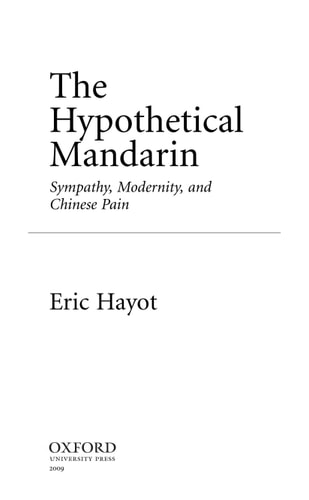
The Hypothetical Mandarin: Sympathy, Modernity, and Chinese Pain (Modernist Literature and Culture)
0
0
As an Amazon Associate and affiliate partner, Menrva Books earns from qualifying purchases. Learn more
Author Description
Why has the West for so long and in so many different ways expressed the idea that the Chinese have a special relationship to cruelty and to physical pain? What can the history of that idea and its expressions teach us about the politics of the West's contemporary relation to China? And what does it tell us about the philosophy of modernity?The Hypothetical Mandarin is, in some sense, a history of the Western imagination. It is also a history of the interactions between Enlightenment philosophy, of globalization, of human rights, and of the idea of the modern. Beginning with Bianchon and Rastignac's discussion of whether the former would, if he could, obtain a European fortune by killing a Chinese mandarin in Balzac's Le Pere Goriot (1835), the book traces a series of literary and historical examples in which Chinese life and European sympathy seem to hang in one another's balance. Hayots wide-ranging discussion draws on accounts of torture, on medical case studies, travelers tales, photographs, plasticized corpses, polemical broadsides, watercolors, and on oil paintings. His analyses show that the historical connection between sympathy and humanity, and indeed between sympathy and reality, has tended to refract with a remarkable frequency through the lens called "China," and why the story of the West's Chinese pain goes to the heart of the relation between language and the body and the social experience of the modern human being.Written in an ebullient prose, The Hypothetical Mandarin demonstrates how the network that intertwines China, sympathy, and modernity continues to shape the economic and human experience.
Menrva's Summary
THE THESIS
This book investigates the historical and philosophical origins of the Western perception that China possesses a unique, inherent relationship to cruelty and physical pain. Eric Hayot, a scholar of modernist literature and culture, examines how this persistent trope functions as a mirror for Western anxieties regarding modernity, human rights, and globalization. By analyzing a diverse array of cultural artifacts, the author argues that the Western concept of 'sympathy' has been fundamentally shaped by its projection onto the Chinese body, revealing deep-seated contradictions in Enlightenment thought and the modern social experience.
THE SCOPE MAP
What You Will Find
- A historical survey of Western literary and visual representations of China from the 19th century to the present.
- Analysis of primary sources including Balzac’s literature, medical case studies, travelers' accounts, and contemporary photography.
- A theoretical framework connecting the philosophy of sympathy to the development of globalized human rights discourse.
- Examination of how the 'Chinese mandarin' trope serves as a recurring motif in Western polemics and aesthetic expression.
THE AUTHORITY PERSPECTIVE
Scholars in the fields of comparative literature and cultural studies frequently cite this work for its rigorous interdisciplinary approach to the history of ideas. Readers often note the academic density of the prose, which effectively bridges the gap between literary analysis and political philosophy.
Page Count:
278
Publication Date:
2009-04-24
Publisher:
Oxford University Press
ISBN-10:
0195382498
ISBN-13:
9780195382495
History
Philosophy
Ethnic Studies
Cultural Anthropology
Asian Studies
Modernism
Sympathy
Literary Criticism
Community Tags
Similar Books