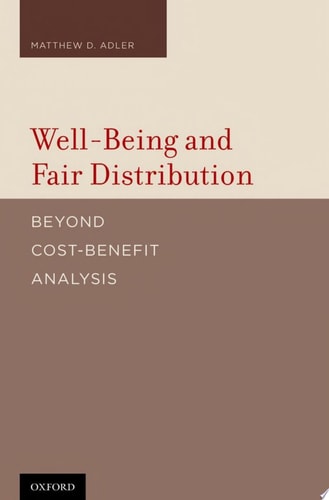
Well-Being and Fair Distribution: Beyond Cost-Benefit Analysis
0
0
As an Amazon Associate and affiliate partner, Menrva Books earns from qualifying purchases. Learn more
Author Description
In Well-Being and Fair Distribution: Beyond Cost-Benefit Analysis, author Matthew D. Adler provides readers with a comprehensive, philosophically grounded argument for the use of social welfare functions as a framework for governmental policy analysis--a framework that is welfarist but not utilitarian, and sensitive to the distribution of human well-being.Well-Being and Fair Distribution addresses a range of relevant theoretical issues, including the nature of well-being and the possibility of interpersonal welfare comparisons; the moral value of equality, and how that bears on the form of the social welfare function; social choice under uncertainty; and the integration of individual responsibility into the social-welfare function approach. Adler also explores issues of implementation by looking at how survey data and other sources of evidence might be used to calibrate both a well-being metric and a social welfare function, and discussing whether distributive goals are ever best pursued through regulation rather than the tax system. In working through this range of theoretical and practical issues, Well-Being and Fair Distribution draws from a wide variety of literatures, including philosophical scholarship on equality, "prioritarianism," responsibility, well-being, and personal identity over time; the social choice literature within economics; applied economic literatures concerning the measurement of inequality and poverty; legal and policy-analytic scholarship on cost-benefit analysis, environmental justice, and the choice between regulation and taxation; and the burgeoning field of "happiness studies."
Menrva's Summary
THE THESIS
This book investigates whether social welfare functions can serve as a more equitable and philosophically robust framework for governmental policy analysis than traditional cost-benefit analysis. Matthew D. Adler, a scholar in law and economics, constructs a welfarist model that prioritizes the distribution of human well-being over simple utilitarian aggregation. By integrating philosophical theories of equality and prioritarianism with economic social choice theory, the author argues for a policy evaluation method that accounts for individual responsibility and interpersonal welfare comparisons.
THE SCOPE MAP
What You Will Find
- A theoretical framework for social welfare functions that moves beyond utilitarianism.
- Methodologies for integrating survey data and happiness studies into policy calibration.
- Analysis of the moral implications of inequality, poverty, and individual responsibility.
- Comparative evaluation of regulatory interventions versus tax-based distributive policies.
THE AUTHORITY PERSPECTIVE
Experts recognize this work as a significant contribution to the intersection of welfare economics and moral philosophy. Readers frequently note the academic density of the prose, which is intended for scholars and practitioners in policy analysis and legal theory.
Page Count:
656
Publication Date:
2011-12-01
Publisher:
Oxford University Press
ISBN-10:
0195384997
ISBN-13:
9780195384994
Philosophy
Economics
Social Science
Public welfare
Public Policy
Community Tags
Similar Books