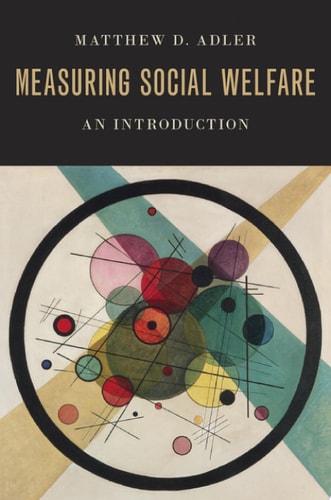
Measuring Social Welfare: An Introduction
0
0
As an Amazon Associate and affiliate partner, Menrva Books earns from qualifying purchases. Learn more
Author Description
Disputes over government policies rage in a number of areas. From taxation to climate change, from public finance to risk regulation, and from health care to infrastructure planning, advocates debate how policies affect multiple dimensions of individual well-being, how these effects balance against each other, and how trade-offs between overall well-being and inequality should be resolved.How to measure and balance well-being gains and losses is a vexed issue. Matthew D. Adler advances the debate by introducing the social welfare function (SWF) framework and demonstrating how it can be used as a powerful tool for evaluating governmental policies. The framework originates in welfare economics and in philosophical scholarship regarding individual well-being, ethics, and distributive justice. It has three core components: a well-being measure, which translates each of the possible policy outcomes into an array of interpersonally comparable well-being numbers, quantifying how well off each person in the population would be in that outcome; a rule for ranking outcomes thus described; and an uncertainty module, which orders policies understood as probability distributions over outcomes. The SWF framework is a significant improvement compared to cost-benefit analysis (CBA), which quantifies policy impacts in dollars, is thereby biased towards the rich, and is insensitive to the distribution of these monetized impacts. The SWF framework, by contrast, uses an unbiased measure of well-being and allows the policymaker to consider both efficiency (total well-being) and equity (the distribution of well-being).Because the SWF framework is a fully generic methodology for policy assessment, Adler also discusses how it can be implemented to inform government policies. He illustrates it through a detailed case study of risk regulation, contrasting the implications of results of SWF and CBA. This book provides an accessible, yet rigorous overview of the SWF approach that can inform po
Menrva's Summary
THE THESIS
This book investigates how the social welfare function (SWF) framework provides a more equitable and rigorous alternative to traditional cost-benefit analysis for evaluating government policy. Matthew D. Adler, a scholar in law and economics, synthesizes concepts from welfare economics and moral philosophy to propose a methodology that accounts for both total well-being and the distribution of outcomes. By moving beyond the monetary focus of cost-benefit analysis, the author argues that policymakers can better address trade-offs between efficiency and equity across diverse sectors such as health care, infrastructure, and climate regulation.
THE SCOPE MAP
What You Will Find
- The three core components of the SWF framework: well-being measures, ranking rules, and uncertainty modules.
- A comparative analysis between the SWF framework and traditional cost-benefit analysis (CBA).
- A detailed case study applying the SWF methodology to risk regulation.
Scope Limits
- The text focuses primarily on the theoretical and methodological application of SWF rather than exhaustive empirical data for every policy area mentioned.
- It does not provide a comprehensive history of all economic welfare theories, focusing instead on the specific SWF approach.
THE AUTHORITY PERSPECTIVE
Experts recognize this work as a significant contribution to the intersection of ethics and public policy, noting its clarity in explaining complex economic frameworks. Readers frequently highlight the text's accessibility for those familiar with policy analysis while maintaining the rigor required for academic study.
Page Count:
334
Publication Date:
2019-01-01
Publisher:
Oxford University Press
ISBN-10:
0190643021
ISBN-13:
9780190643027
Economics
Public welfare
Public Policy
Political Philosophy
Social Science
Community Tags
Similar Books