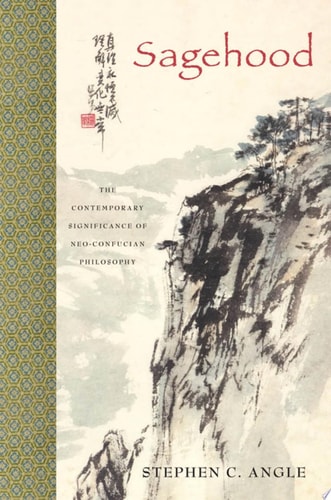
Sagehood: The Contemporary Significance of Neo-Confucian Philosophy
0
0
As an Amazon Associate and affiliate partner, Menrva Books earns from qualifying purchases. Learn more
Author Description
Neo-Confucianism is the sophisticated revival of Confucian theorizing, responding to challenges from Buddhism and Daoism, which began around 1000 C.E. and came to dominate the Chinese intellectual scene for centuries thereafter. What would happen if we took Neo-Confucianism and its central ideal of sagehood seriously as contemporary philosophy? Sagehood represents supreme human virtue: a flawless, empathetic responsiveness to every situation in which one finds oneself. How could this be possible? How might one work toward such a state? According to Neo-Confucians, we should all strive to become sages, whether or not we ultimately achieve it. Taking neo-Confucianism seriously means to explore the ways that its theories of psychology, ethics, education, and politics engage with the views of contemporary philosophers. Angle's book is therefore both an exposition of Neo-Confucian philosophy and a sustained dialogue with many leading Western thinkers--and especially with those philosophers leading the current renewal of interest in virtue ethics. The book's significance is two-fold: it argues for a new stage in the development of contemporary Confucian philosophy, and it demonstrates the value to Western philosophers of engaging with the Neo-Confucian tradition.
Menrva's Summary
THE THESIS
This book investigates whether the Neo-Confucian ideal of sagehood can function as a viable and significant framework within contemporary philosophical discourse. Stephen C. Angle, a scholar of Chinese philosophy, utilizes historical Neo-Confucian texts to construct a bridge between traditional Chinese thought and modern Western analytic philosophy. By examining the psychological, ethical, and political dimensions of sagehood, the author argues that this tradition offers unique insights that can advance current debates in virtue ethics and moral philosophy.
THE SCOPE MAP
What You Will Find
- A historical overview of Neo-Confucianism originating from 1000 C.E.
- A comparative analysis between Neo-Confucian theories and Western virtue ethics.
- Examination of the practical application of sagehood in modern psychology and education.
- A proposed framework for integrating Eastern and Western philosophical traditions.
THE AUTHORITY PERSPECTIVE
Scholars and critics recognize this work as a significant contribution to comparative philosophy, noting its ability to move beyond mere exposition into original philosophical synthesis. Experts frequently highlight the text as a bridge between disparate academic traditions, making it a valuable resource for those interested in the intersection of analytic philosophy and Chinese intellectual history.
Page Count:
310
Publication Date:
2009-10-19
Publisher:
Oxford University Press
ISBN-10:
0195385144
ISBN-13:
9780195385144
Philosophy
Ethics
Virtue Ethics
Confucianism
Comparative Philosophy
Community Tags
Similar Books