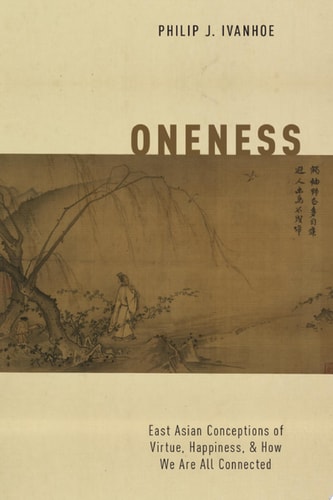
Oneness: East Asian Conceptions of Virtue, Happiness, and How We Are All Connected
0
0
As an Amazon Associate and affiliate partner, Menrva Books earns from qualifying purchases. Learn more
Author Description
At the center of a constellation of key ideas in East Asian philosophical traditions, there lies a conception of oneness among human beings. Human beings are intricately and inextricably intertwined and share a common destiny with other people, creatures, and things. The ramifications of this idea are wide-reaching, and resonate with important debates and concerns in contemporary Western philosophy, but many at the forefront of their fields in the West are unaware of the fundamental shift in perspective that might be available to them. One of Ivanhoe's aims in this work is to challenge the dominant paradigm of hyper-individualism, which still enjoys a commanding position in a great deal of contemporary theory and practice in the humanities and social sciences, and to describe and advocate for an alternative conception and sense of self, world, and the relationship between them.In particular, Ivanhoe, who has an extensive background in and has published influential work on virtue ethics and Asian philosophy, investigates the implications of oneness for conceptions of the self, virtue, and human happiness. Through the lens of oneness, he explores topics such as conceptions of the self, selfishness and self-centeredness, virtues, spontaneity, and happiness, drawing support from wide-ranging, interdisciplinary sources. Rather than starting from the standpoint of Western philosophy and then reaching out to Asian philosophy from a distance, Ivanhoe advances a thesis drawn from East Asian sources and explicitly challenges the theoretical asymmetry that is characteristic of most comparative study, which often simply applies Western theories to non-Western material.
Menrva's Summary
THE THESIS
This book investigates the philosophical concept of oneness within East Asian traditions to challenge the dominant Western paradigm of hyper-individualism. Philip J. Ivanhoe, a scholar specializing in virtue ethics and Asian philosophy, utilizes a wide array of interdisciplinary sources to argue that human beings are fundamentally interconnected. He proposes that adopting this East Asian perspective offers a necessary alternative to current Western theories regarding the self, virtue, and human happiness.
THE SCOPE MAP
What You Will Find
- Analysis of East Asian philosophical conceptions of the self and interconnectedness
- Exploration of virtues, spontaneity, and happiness through the lens of oneness
- A critique of theoretical asymmetry in comparative philosophy
- Interdisciplinary synthesis of historical and contemporary thought
Scope Limits
- Does not provide a comprehensive history of all East Asian philosophical schools
- Does not focus on practical self-help exercises, remaining primarily within the realm of theoretical philosophy
THE AUTHORITY PERSPECTIVE
Scholars and readers recognize this work as a significant contribution to comparative philosophy that successfully shifts the focus away from Western-centric analytical frameworks. Experts highlight the text for its academic rigor and its ability to bridge the gap between traditional Asian thought and contemporary Western philosophical concerns.
Page Count:
204
Publication Date:
2017-01-01
Publisher:
Oxford University Press
ISBN-10:
0190840536
ISBN-13:
9780190840532
Religion
Philosophy
Social Theory
Comparative Philosophy
Self Philosophy
Whole And Parts philosophy
Ethics
Eastern
Special Topics
Virtue Ethics
East Asian
Community Tags
Similar Books