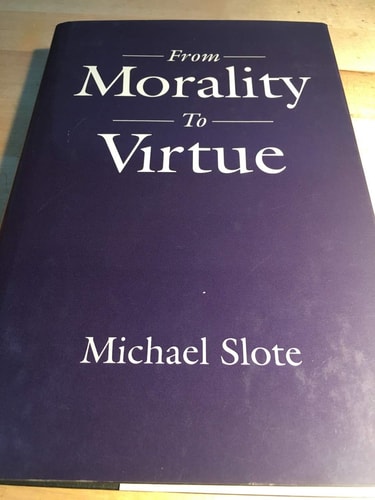
From Morality to Virtue
0
0
As an Amazon Associate and affiliate partner, Menrva Books earns from qualifying purchases. Learn more
Author Description
In this book, Slote offers the first full-scale foundational account of virtue ethics to have appeared since the recent revival of interest in the ethics of virtue. Slote advocates a particular form of such ethics for its intuitive and structural advantages over Kantianism, utilitarianism, and common-sense morality, and he argues that the problems of other views can be avoided and a contemporary plausible version of virtue ethics achieved only by abandoning specifically moral concepts for general aretaic notions like admirability and virtue. Although this study is not bound by particular Aristotelian doctrines, it places an Aristotelian emphasis on both self-benefiting and other-benefiting virtues. Slote criticizes Kantian and common-sense morality for internal incoherencies and for downgrading the moral individual and her well-being in some previously unnoticed ways. By contrast, this book defends a distinctive, intuitive, and symmetric ethical principle according to which we should balance self-concern with concern for others, but it also concludes that there is, contrary to utilitarianism, no single basis for status as a virtue nor any simple relation between the virtues and human well-being.
Menrva's Summary
THE THESIS
This work investigates whether a contemporary, plausible version of virtue ethics can be achieved by replacing traditional moral concepts with general aretaic notions such as admirability and virtue. Michael Slote, a prominent philosopher, utilizes a comparative analysis of Kantianism, utilitarianism, and common-sense morality to identify structural flaws in these dominant frameworks. He proposes an alternative ethical model that emphasizes a symmetric balance between self-benefiting and other-benefiting virtues, moving away from rigid Aristotelian doctrines while maintaining a focus on the individual's well-being.
THE SCOPE MAP
What You Will Find
- A foundational critique of Kantian and utilitarian ethical structures
- A proposed aretaic framework centered on the concept of admirability
- An analysis of the relationship between self-concern and concern for others
- A discussion on the lack of a single basis for virtue status
Scope Limits
- The text does not provide a comprehensive history of all virtue ethics traditions
- It does not offer a prescriptive guide for daily moral decision-making
THE AUTHORITY PERSPECTIVE
Scholars and students of moral philosophy frequently cite this work as a significant contribution to the modern revival of virtue ethics. Experts note the text's academic density and its rigorous challenge to established deontological and consequentialist norms.
Page Count:
287
Publication Date:
1995-01-01
Publisher:
Oxford University Press
ISBN-10:
0190208104
ISBN-13:
9780190208103
Philosophy
History & Surveys
Virtue Ethics
Ethics
Academic
Utilitarianism
Moral Philosophy
Common sense