War: Antiquity and Its Legacy
0
0
As an Amazon Associate and affiliate partner, Menrva Books earns from qualifying purchases. Learn more
Author Description
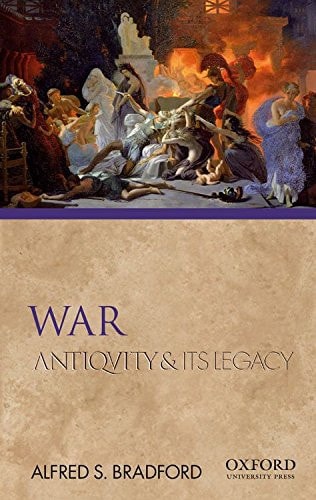
By one estimate, humans have fought wars in ninety-four out of every hundred years for the past 5,000. Despite radical differences in the prosecution of warfare between ancient and modern societies, there remains a linear connection to the ways that Greco-Roman cultures thought about war--its conduct, aims, tactics, and ethics. This is epitomized most obviously in the Greek and Latin derivatives that dot our language of war--"army,"military, "strategy." Combining astute analyses of the logistics of conflict with the ethics of war, Alfred Bradford offers fascinating parallels between warfare in ancient and contemporary societies. After a brief prelude that discusses the Greeks' first descriptions of battle in the Iliad, Bradford outlines the changes in warfare from the earliest records through the fall of the Roman Empire to contemporary wars of counterterrorism. The second half of the book turns to discuss more holistically the study of war, the writing of war, and images of war, drawing on a diverse range of texts and images. Fundamentally, Bradford shows that despite massive differences in weaponry and firepower, the basic principles of warfare have remained unchanged over thousands of years, and even as we move further from antiquity, war in the modern age is persistently illuminated by our Greek and Roman forbearers.
Menrva's Summary
THE THESIS
This work investigates the enduring continuity of military principles, ethics, and strategic thought from Greco-Roman antiquity to the contemporary era. Alfred S. Bradford, a scholar of ancient history, utilizes a comparative framework to bridge the gap between ancient combat practices and modern warfare. By examining linguistic roots, tactical evolution, and the philosophical underpinnings of conflict, he argues that the fundamental nature of war remains tethered to its classical origins despite significant advancements in weaponry and technology.
THE SCOPE MAP
What You Will Find
- A historical survey of warfare from the Iliad through the decline of the Roman Empire.
- Analysis of the linguistic and conceptual evolution of military terminology.
- Comparative case studies linking ancient tactical logistics to modern counterterrorism operations.
- An examination of how war is documented, written about, and visually represented across different eras.
THE AUTHORITY PERSPECTIVE
Experts recognize this text as a bridge between classical scholarship and modern military analysis, noting its accessible approach to complex historical themes. Readers frequently highlight the author's ability to synthesize vast timelines into a coherent argument regarding the persistent nature of human conflict.
Page Count:
224
Publication Date:
2015-03-01
Publisher:
Oxford University Press
ISBN-10:
0195380916
ISBN-13:
9780195380910
History
Military Science
Warfare
Ancient History
Battles
Military History
Community Tags
Similar Books