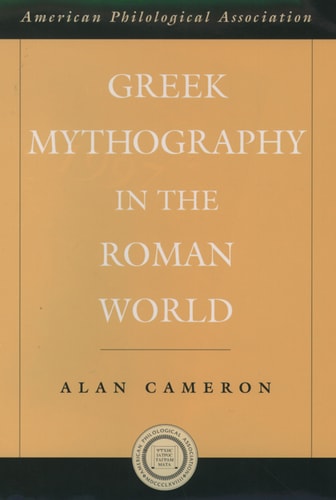
Greek Mythography in the Roman World
0
0
As an Amazon Associate and affiliate partner, Menrva Books earns from qualifying purchases. Learn more
Author Description
By the Roman age the traditional stories of Greek myth had long since ceased to reflect popular culture. Mythology had become instead a central element in elite culture. If one did not know the stories one would not understand most of the allusions in the poets and orators, classics and contemporaries alike; nor would one be able to identify the scenes represented on the mosaic floors and wall paintings in your cultivated friends' houses, or on the silverware on their tables at dinner.Mythology was no longer imbibed in the nursery; nor could it be simply picked up from the often oblique allusions in the classics. It had to be learned in school, as illustrated by the extraordinary amount of elementary mythological information in the many surviving ancient commentaries on the classics, notably Servius, who offers a mythical story for almost every person, place, and even plant Vergil mentions. Commentators used the classics as pegs on which to hang stories they thought their students should know.A surprisingly large number of mythographic treatises survive from the early empire, and many papyrus fragments from lost works prove that they were in common use. In addition, author Alan Cameron identifies a hitherto unrecognized type of aid to the reading of Greek and Latin classical and classicizing texts--what might be called mythographic companions to learned poets such as Aratus, Callimachus, Vergil, and Ovid, complete with source references. Much of this book is devoted to an analysis of the importance evidently attached to citing classical sources for mythical stories, the clearest proof that they were now a part of learned culture. So central were these source references that the more unscrupulous faked them, sometimes on the grand scale.
Menrva's Summary
THE THESIS
This work investigates how Greek mythology transitioned from a living oral tradition into a codified, academic subject within the elite educational systems of the Roman Empire. Alan Cameron, a distinguished scholar of late antiquity, utilizes a vast array of papyrological evidence, ancient commentaries, and literary treatises to argue that mythology became a prerequisite for social and intellectual participation among the Roman elite. He demonstrates that the necessity of understanding mythological allusions in classical texts led to the creation of specialized mythographic manuals and pedagogical aids.
THE SCOPE MAP
What You Will Find
- Analysis of mythographic treatises and papyrus fragments from the early Roman Empire.
- Examination of the role of ancient commentators like Servius in standardizing mythological knowledge.
- Investigation into the practice of citing classical sources to validate mythological narratives.
- Identification of previously unrecognized 'mythographic companions' for poets such as Vergil and Ovid.
Scope Limits
- The study focuses primarily on the elite educational and cultural context rather than popular or folk mythology.
- It does not provide a comprehensive retelling of the myths themselves, but rather an analysis of their transmission and usage.
THE AUTHORITY PERSPECTIVE
Scholars recognize this text as a significant contribution to the study of ancient intellectual history and the reception of classical literature. Readers frequently note the academic density of the prose and the meticulous attention to source citations, making it a primary resource for classicists and historians of the Roman period.
Page Count:
362
Publication Date:
2004-01-01
Publisher:
Oxford University Press
ISBN-10:
0190291095
ISBN-13:
9780190291099
History
Mythology
Ancient - Rome
Ancient History
English & College Success
Ancient Greece
Literary Criticism
English
Community Tags
Other Editions(3)

Similar Books










Reader Comments
Share Your Thoughts
No comments yet. Be the first to share your thoughts!