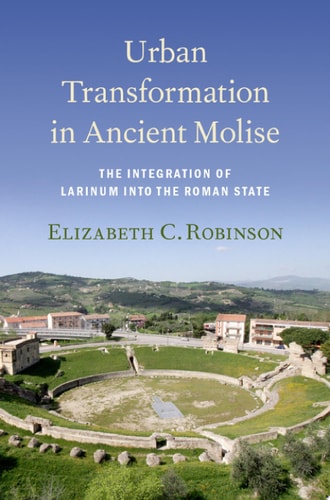
Urban Transformation in Ancient Molise: The Integration of Larinum into the Roman State
0
0
As an Amazon Associate and affiliate partner, Menrva Books earns from qualifying purchases. Learn more
Author Description
Larinum, a pre-Roman town in the modern region of Molise, underwent a unique transition from independence to municipal status when it received Roman citizenship in the 80s BCE shortly after the Social War. Its trajectory during this period illuminates complex processes of cultural, social, and political change associated with the Roman conquest throughout the Italian peninsula in the first millennium BCE. This book uses all the available evidence to create a site biography of Larinum from 400 BCE to 100 CE, with a focus on the urban transformation that occurred there during the Roman conquest. This study is distinctive in utilizing many different types of evidence: literary sources (including the pro Cluentio), settlement patterns, inscriptions, monuments and artifacts. It highlights the importance of local isolated variability in studies of Roman conquest, and provides a narrative that supplements larger works on this theme.
Menrva's Summary
THE THESIS
This book investigates the specific urban and cultural transformation of Larinum as it transitioned from an independent pre-Roman town to a Roman municipality following the Social War. Elizabeth C. Robinson utilizes a multi-disciplinary approach to analyze the integration of this Molise settlement into the Roman state. By synthesizing diverse archaeological and literary evidence, the author argues that local variability is essential to understanding the broader mechanics of Roman conquest across the Italian peninsula.
THE SCOPE MAP
What You Will Find
- A comprehensive site biography of Larinum spanning 400 BCE to 100 CE.
- Analysis of settlement patterns, epigraphic evidence, and architectural monuments.
- Integration of literary sources, specifically Cicero's pro Cluentio, with material culture.
Scope Limits
- The study is geographically confined to the specific site of Larinum and its immediate territory.
- The analysis does not attempt to provide a general history of the Roman Republic beyond its relevance to Larinum.
THE AUTHORITY PERSPECTIVE
Scholars recognize this work as a valuable micro-historical study that challenges monolithic narratives of Romanization. Experts frequently highlight the author's methodological rigor in balancing disparate archaeological datasets with classical texts.
Page Count:
363
Publication Date:
2021-01-01
Publisher:
Oxford University Press
ISBN-10:
0190641452
ISBN-13:
9780190641450
History
Urban History
Italy
Ancient History
History of Architecture
Humanities
Archaeology
Ancient - Rome
Italy history
Professional Career & Trade
Community Tags
Similar Books