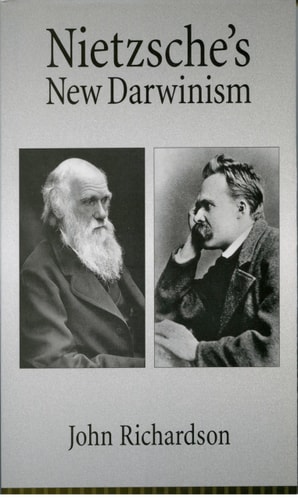
Nietzsche's New Darwinism
0
0
As an Amazon Associate and affiliate partner, Menrva Books earns from qualifying purchases. Learn more
Author Description
Nietzsche wrote in a scientific culture transformed by Darwin. He read extensively in German and British Darwinists, and his own works dealt often with such obvious Darwinian themes as struggle and evolution. Yet most of what Nietzsche said about Darwin was hostile: he sharply attacked many of his ideas, and often slurred Darwin himself as "mediocre." So most readers of Nietzsche have inferred that he must have cast Darwin quite aside.But in fact, John Richardson argues, Nietzsche was deeply and pervasively influenced by Darwin. He stressed his disagreements, but was silent about several core points he took over from Darwin. Moreover, Richardson claims, these Darwinian borrowings were to Nietzsche's credit: when we bring them to the surface we discover his positions to be much stronger than we had thought. Even Nietzsche's radical innovations are more plausible when we expose their Darwinian ground; we see that they amount to a "new Darwinism."The book's four chapters show how four of Nietzsche's most problematic ideas benefit from this Darwinian setting. These are: his claim that life is "will to power," his insistence that his values are "higher" yet also "just his," his disturbing ethics of selfishness and politics of inequality, and his elevation of aesthetic over moral values. Richardson argues that each of these Nietzschean ideas has a clearer and stronger sense when set on the scientific ground he takes from Darwin.
Menrva's Summary
THE THESIS
This book investigates the extent to which Friedrich Nietzsche’s philosophical framework was fundamentally shaped by the scientific advancements of Charles Darwin, despite Nietzsche’s public hostility toward Darwinian thought. John Richardson, a scholar of Nietzschean philosophy, examines the intellectual intersection between 19th-century evolutionary theory and Nietzsche’s core concepts. By analyzing Nietzsche’s private reading habits and his engagement with German and British Darwinists, Richardson argues that Nietzsche’s most radical ideas are more coherent and robust when viewed as a development of Darwinian principles rather than a rejection of them.
THE SCOPE MAP
What You Will Find
- An analysis of Nietzsche’s engagement with 19th-century German and British evolutionary biology.
- A re-evaluation of the 'will to power' as a concept rooted in biological struggle.
- A critical examination of Nietzsche’s ethics of selfishness and his aesthetic hierarchy.
- A methodology that reconciles Nietzsche’s overt criticisms of Darwin with his underlying reliance on evolutionary mechanisms.
THE AUTHORITY PERSPECTIVE
Scholars recognize this work as a significant contribution to the study of Nietzsche’s intellectual development, particularly regarding his relationship with contemporary science. Readers frequently note the academic density of the prose, which requires a solid foundation in both philosophical history and evolutionary theory to fully appreciate the author's arguments.
Page Count:
304
Publication Date:
2008-09-22
Publisher:
Oxford University Press
ISBN-10:
0195380290
ISBN-13:
9780195380293
Politics
Philosophy
Intellectual History
Categories
Kindle eBooks
History & Surveys
Kindle Store
Evolutionary Biology
Community Tags
Similar Books