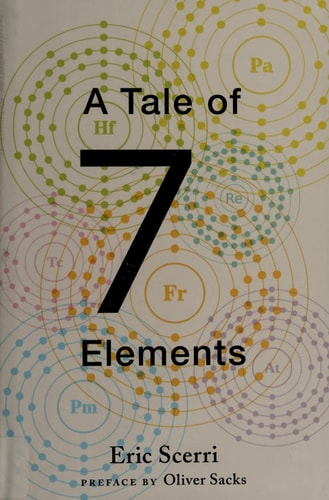
A Tale of Seven Elements
0
0
As an Amazon Associate and affiliate partner, Menrva Books earns from qualifying purchases. Learn more
Author Description
In 1913, English physicist Henry Moseley established an elegant method for "counting" the elements based on atomic number, ranging them from hydrogen (#1) to uranium (#92). It soon became clear, however, that seven elements were mysteriously missing from the lineup--seven elements unknown to science.In his well researched and engaging narrative, Eric Scerri presents the intriguing stories of these seven elements--protactinium, hafnium, rhenium, technetium, francium, astatine and promethium. The book follows the historical order of discovery, roughly spanning the two world wars, beginning with the isolation of protactinium in 1917 and ending with that of promethium in 1945. For each element, Scerri traces the research that preceded the discovery, the pivotal experiments, the personalities of the chemists involved, the chemical nature of the new element, and its applications in science and technology. We learn for instance that alloys of hafnium--whose name derives from the Latin name for Copenhagen (hafnia)--have some of the highest boiling points on record and are used for the nozzles in rocket thrusters such as the Apollo Lunar Modules. Scerri also tells the personal tales of researchers overcoming great obstacles. We see how Lise Meitner and Otto Hahn--the pair who later proposed the theory of atomic fission--were struggling to isolate element 91 when World War I intervened, Hahn was drafted into the German army's poison gas unit, and Meitner was forced to press on alone against daunting odds. The book concludes by examining how and where the twenty-five new elements have taken their places in the periodic table in the last half century.A Tale of Seven Elements paints a fascinating picture of chemical research--the wrong turns, missed opportunities, bitterly disputed claims, serendipitous findings, accusations of dishonesty--all leading finally to the thrill of discovery.
Menrva's Summary
THE THESIS
How did the scientific community identify and isolate the seven missing elements that remained absent from the periodic table following Henry Moseley's 1913 breakthrough? Eric Scerri, a prominent historian and philosopher of science, utilizes primary source documentation and historical records to reconstruct the timeline of chemical discovery between 1917 and 1945. The text argues that the identification of these elements was not merely a linear progression of logic, but a complex human endeavor shaped by geopolitical instability, individual perseverance, and the evolution of experimental methodology. By examining the specific laboratory conditions and the personal lives of the researchers involved, Scerri provides a comprehensive framework for understanding the final completion of the natural periodic table.
THE SCOPE MAP
What You Will Find
- A detailed historical account of the isolation of protactinium, hafnium, rhenium, technetium, francium, astatine, and promethium.
- Analysis of the experimental techniques and chemical theories that allowed scientists to bridge the gaps in the periodic table.
- Biographical insights into the challenges faced by researchers like Lise Meitner and Otto Hahn during the World War I era.
- An examination of the long-term applications of these elements in modern technology, including aerospace engineering.
THE AUTHORITY PERSPECTIVE
Experts and historians of science frequently highlight this work as a definitive account of the final stages of elemental discovery. Readers often note the balance between technical chemical detail and the human drama of the researchers, making it accessible to both students and professionals in the field.
Page Count:
304
Publication Date:
2013-06-20
Publisher:
Oxford University Press
ISBN-10:
0195391314
ISBN-13:
9780195391312
Biography
Science
History
Chemistry
Community Tags
Other Editions(3)

Similar Books





Reader Comments
Share Your Thoughts
No comments yet. Be the first to share your thoughts!